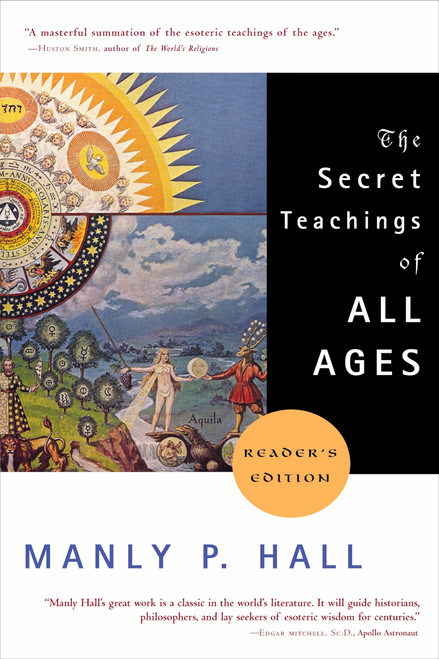
The Secret Teachings of All Ages
Reader’s Edition
by Manly P. Hall
Like no other book of the twentieth century, Manly P. Hall's legendary The Secret Teachings of All Ages is a codex to the ancient occult and esoteric traditions of the world. Students of hidden wisdom, ancient symbols, and arcane practices treasure Hall's magnum opus above all other works.
While many thousands of copies have sold since its initial publication in 1928, The Secret Teachings of All Ages has previously been available only in oversized, expensive editions. For the first time, Hall's celebrated classic is now published in an affordable trade paperback volume. Literally hundreds of entries shine a rare light on some of the most fascinating and closely held aspects of myth, religion, and philosophy from throughout the centuries.
About this Edition
A classic since 1928, this masterly encyclopaedia of ancient mythology, ritual, symbolism, and the arcane mysteries of the ages is available for the first time in a compact "reader's edition."
More than one hundred line drawings and a sixteen-page colour insert reproduce some of the finest illustrations of the original book, while reset and reformatted text makes this edition of The Secret Teachings of All Ages newly accessible to readers everywhere.
____________________________________________________________
Table of Contents
Preface to the Reader’s Edition
Preface to the Diamond Jubilee Edition
Foreword
Preface
I Introduction
II The Ancient Mysteries and Secret Societies Which Have Influenced Modern Masonic Symbolism, PART I
Ancient systems of education—Celsus concerning the Christians—Knowledge necessary to right living—The Druidic Mysteries of Britain and Gaul—The Rites of Mithras—The Mithraic and Christian Mysteries contrasted
III The Ancient Mysteries and Secret Societies, PART II
The Gnostic Mysteries—Simon Magus and Basilides—Abraxas, the Gnostic concept of Deity—The Mysteries of Serapis—Labyrinth symbolism—The Odinic, or Goth, Mysteries
IV The Ancient Mysteries and Secret Societies, PART III
The Eleusinian Mysteries—The Lesser Rites—The Greater Rites—The Orphic Mysteries—The Bacchic Mysteries—The Dyonysiac Mysteries
V Atlantis and the Gods of Antiquity
Plato’s Atlantis in the light of modern science—The Myth of the Dying God—The Rite of Tammuz and Ishtar—The Mysteries of Atys and Adonis—The Rites of Sabazius—Tha Cabiric Mysteries of Samothrace
VI The Life and Writings of Thoth Hermes Trismegistus
Suppositions concerning identity of Hermes—The mutilated Hermetic fragments—The Book of Thoth—Poimandres, the Vision of Hermes—The Mystery of Universal Mind—The Seven Governors of the World
VII The Initiation of the Pyramid
The opening of the Great Pyramid by Caliph al Mamoun—The passageways and chambers of the Great Pyramid—The riddle of the Sphinx—The Pyramid Mysteries—The secret of the Pyramid coffer—The swelling place of the Hidden God
VIII Isis, the Virgin of the World
The birthdays of the gods—The murder of Osiris—The Hermetic Isis—The symbols peculiar to Isis—The Troubadours—The mummification of the dead
IX The Sun, a Universal Deity
The Solar Trinity—Christianity and the Sun—The birthday of the Sun—The three Suns—The celestial inhabitants of the Sun—The midnight Sun
X The Zodiac and Its Signs
Primitive astronomical instruments—The equinoxes and solstices—The astrological ages of the world—The circular zodiac of Tentyra—An interpretation of the zodiacal signs—The horoscope of the world
XI The Bembine Table of Isis
Plato’s initiation in the Great Pyramid—The history of the Bembine Table—Platonic theory of ideas—The interplay of the three philosophical zodiacs—The Chaldean philosophy of triads—The Orphic Egg
XII Wonders of Antiquity
The ever-burning lamps—The oracle of Delphi—The Dodonean oracle—The oracle of Trophonius—The Seven Wonders of the world—The initiated architects
XIII The Life and Philosophy of Pythagoras
Pythagoras and the School of Crotona—Pythagoric fundamentals—The symmetrical solids—The symbolic aphorisms of Pythagoras—Pythagorean astronomy—Kepler’s theory of the universe
XIV Pythagorean Mathematics
The theory of numbers—The numerical values of letters—Method of securing the numerical power of words—An introduction to the Pythagorean theory of numbers—The sieve of Eratosthenes—The meanings of the ten numbers
XV The Human Body in Symbolism
The philosophical manikin—The three universal centers—The temples of initiation—The hand in symbolism—The greater and lesser man—The Anthropos, or Oversoul
XVI The Hiramic Legend
The building of Solomon’s Temple—The murder of CHiram Abiff—The martyrdom of Jacques de Molay—The spirit fire and the pineal gland—The wanderings of the astronomical CHiram—Cleopatra’s Needle and Mason’s marks
XVII The Pythagorean Theory of Music and Color
Pythagoras and the diatonic scale—Therapeutic music—The music of the spheres—The use of color in symbolism—The colors of the spectrum and the musical scale—Zodiacal and planetary colors
XVIII Fishes, Insects, Animals, Reptiles, and Birds, PART I
Jonah and the whale—The fish, the symbol of Christ—The Egyptian scarab—Jupiter’s fly—The serpent of wisdom—The sacred crocodile
IXX Fishes, Insects, Animals, Reptiles, and Birds, PART II
The dove, the yonic emblem—The self-renewing phoenix—The Great Seal of the United States of America—Bast, the cat goddess of the Ptolemies—Apis, the sacred bull—The monoceros, or unicorn
XX Flowers, Plants, Fruits, and Trees
The flower, a phallic symbol—The lotus blossom—The Scandinavian World Tree, Yggdrasil—The sprig of acacia—The juice of the grape—The magical powers of the mandrake
XXI Stones, Metals, and Gems
Prehistoric monuments—The tablets of the Law—The Holy Grail—The ages of the world—Talismanic jewels—Zodiacal and planetary stones and gems
XXII Ceremonial Magic and Sorcery
The black magic of Egypt—Doctor Johannes Faustus—The Mephistopheles of the Grimoires—The invocation of the spirits—Pacts with demons—The symbolism of the pentagram
XXIII The Elements and Their Inhabitants
The Paracelsian theory of submundanes—The orders of elemental beings—The Gnomes, Undines, Salamanders, and Sylphs—Demonology—The incubus and succubus—Vampirism
XXIV Hermetic Pharmacology, Chemistry, and Therapeutics
The healing methods of Paracelsus—Palingenesis—Hermetic theories concerning the cause of disease—Medicinal properties of herbs—The use of drugs in the Mysteries—The sect of the Assassins
XXV The Qabbalah, the Secret Doctrine of Israel
The written and unwritten laws—The origin of the Qabbalistic writings—Rabbi Simeon ben Jochai—The great Qabbalistic books—The divisions of the Qabbalistic system—The Sepher Yetzirah
XXVI Fundamentals of Qabbalistic Cosmogony
AIN SOPH and the Cosmic Egg—The Qabbalistic system of worlds—The Qabbalistic interpretation of Ezekiel’s vision—The great image of Nebuchadnezzar’s dream—The Grand Man of the universe—The fifty gates of life
XXVII The Tree of the Sephiroth
The thirty-two paths of wisdom—The Greater and the Lesser Face—Kircher’s Sephirothic Tree—The mystery of Daath—The three pillars supporting the Sephirothic Tree—The four letters of the Sacred Name
XXVIII Qabbalistic Keys to the Creation of Man
Gematria, Notarikon, and Temurah—The Elohim—The four Adams—Arabian traditions concerning Adam—Adam as the archetype of mankind—The Early Christian Church on the subject of marriage
XXIX An Analysis of the Tarot Cards
The origin of playing cards—The rota mundi of the Rosicrucians—The problem of Tarot symbolism—The unnumbered card—The symbolism of the twenty-one major trumps—The suit cards
XXX The Tabernacle in the Wilderness
Moses, the Egyptian initiate—The building of the Tabernacle—The furnishings of the Tabernacle—The Ark of the Covenant—The Robes of Glory—The Urim and Thummim
XXXI The Fraternity of the Rose Cross
The life of Father C.R.C—Johann Valentin Andræ—The alchemical teachings of the Rosicrucians—Significance of the Rose Cross—The Rosicrucian Temple—The adepts of the Rose Cross
XXXII Rosicrucian Doctrines and Tenets
The Confessio Fraternitatis—The Anatomy of Melancholy—John Heydon on Rosicrucianism—The three mountains of the wise—The philosophical egg—The objects of the Rosicrucian Order
XXXIII Fifteen Rosicrucian and Qabbalistic Diagrams
Schamayim, the Ocean of Spirit—The Seven Days of Creation—The symbolic tomb of Christian Rosencreutz—The regions of the elements—The New Jerusalem—The grand secret of Nature
XXXIV Alchemy and Its Exponents
The multiplication of metals—The medal of Emperor Leopold I—Paracelsus of Hohenheim—Raymond Lully—Nicholas Flammel—Count Bernard of Treviso
XXXV The Theory and Practice of Alchemy, PART I
The origin of alchemical philosophy—Alexander the Great and the talking trees—Nature and art—Alchemical symbolism—The Song of Solomon—The Philosopher’s Gold
XXXVI The Theory and Practice of Alchemy, PART II
The alchemical prayer—The Emerald Tablet of Hermes—A letter from the Brothers of R.C.—The magical Mountain of the Moon—An alchemical formula—The dew of the sages
XXXVII The Chemical Marriage
Christian Rosencreutz is invited to the CHemical Wedding—The Virgo Lucifera—The philosophical Inquisition—The Tower of Olympus—The homunculi—The Knights of the Golden Stone
XXXVIII Bacon, Shakspere, and the Rosicrucians
The Rosicrucian mask—Life of William Shakspere—Sir Francis Bacon—The acrostic signatures—The significant number thirty-three—The philosophic death
XXXIX The Cryptogram as a Factor in Symbolic Philosophy
Secret alphabets—The biliteral cipher—Pictorial ciphers—Acroamatic ciphers—Numerical and musical ciphers—Code ciphers
XL Freemasonic Symbolism
The pillars raised by the son of Seth—Enoch and the Royal Arches—The Dionysiac Architects—The Roman Collegia—Solomon, the personification of Universal Wisdom—Freemasonry’s priceless heritage
XLI Mystic Christianity
St. Iranæus on the life of Christ—The original name of Jesus—The Christened man—The Essenes—The Arthurian cycle—Merlin the Mage
XLII The Cross and the Crucifixion
The Aurea Legenda—The lost libraries of Alexandria—The cross in pagan symbolism—The crucifixion, a cosmic allegory—The crucifixion of Quetzalcoatl—The nails of the Passion
XLIII The Mystery of the Apocalypse
The sacred city of Ephesus—The authorship of the Apocalypse—The Alpha and Omega—The Lamb of God—The Four Horsemen—The number of the beast
XLIV The Faith of Islam
The life of Mohammed—The revelation of the Koran—The valedictory pilgrimage—The tomb of the Prophet—The Caaba at Mecca—The secret doctrine of Islam
XLV American Indian Symbolism
The ceremony of the peace pipe—The historical hiawatha—The Popol Vuh—American Indian sorcery—The Mysteries of Xibalba—The Midewiwin
XLVI The Mysteries and Their Emissaries
The Golden Chain of Homer—Hypatia, the Alexandrian Neo-Platonist—The “divine” Cagliostro—The Comte de St.-Germain—The designing of the American flag—The Declaration of Independence
XLVII Conclusion
Bibliography
Index
About the Author
____________________________________________________________
Paperback Edition
768 pages.
ISBN: 9781585422500
____________________________________________________________
Press, reviews, endorsements
“There aren’t too many books which you can describe as life-changing. Manly P. Hall’s The Secret Teachings of All Ages was one of those books for me... This is a work to be treasured.”
The Daily Grail - read the full review here
____________________________________________________________
About the Author
Manly Palmer Hall (1901 – 1990) was a Canadian writer, lecturer, astrologer, and mystic. Over his 70-year career he gave thousands of lectures and published over 150 volumes, of which the best known is The Secret Teachings of All Ages (1928). In 1934, he founded the Philosophical Research Society in Los Angeles.