

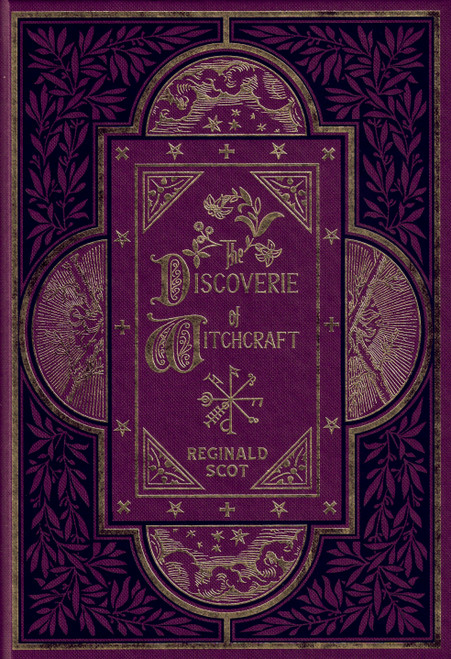
The Discoverie of Witchcraft
by Reginald Scot
edited by Paul Summers Young
The Discoverie of Witchcraft, published by Reginald Scot in 1584, is a groundbreaking work that challenges the existence of witchcraft and the widespread persecution of alleged witches. It is special for its comprehensive documentation of magical practices, spells, and conjurations, making it one of the earliest compendiums of magic and witchcraft. While aiming to debunk superstitions, Scot meticulously catalogued the occult knowledge of his time, preserving a wealth of information about historical magical traditions. The book promotes scepticism and rationalism while serving as an invaluable resource on early modern occultism.
Scot was deeply motivated by a desire to oppose the irrational and un-Christian prosecution of alleged witches. He held the Roman Catholic Church largely responsible for perpetuating these superstitions and targeted prominent writers such as Jean Bodin, author of Démonomanie des Sorciers, and Jacobus Sprenger, co-author of the infamous Malleus Maleficarum. In contrast, Scot respected figures like Heinrich Cornelius Agrippa and Johann Weyer, adopting some of their more rational views on demonology.
____________________________________________________________
Table of Contents
Editor’s Preface
THE DISCOVERIE OF WITCHCRAFT
The Epistle
The First Book
An impeachment of witches’ power in meteors and elementary bodies,
tending to the rebuke of such as attribute too much unto them.
The Second Book
What testimonies and witnesses are allowed to give evidence
against reputed witches, by the report and allowance of the inquisitors
themselves, and such as are special writers herein.
The Third Book
The witches’ bargain with the Devil, according to Malleus Maleficarum,
Bodin, Nider, Danæus, Psellus, Erastus, Heningius, Cumanus, Aquinas,
Batholomæus, Spineus, &c.
The Fourth Book
Of witchmongers’ opinions concerning evil spirits, how they
frame themselves in more excellent sort than God made us.
The Fifth Book
Of transformations, ridiculous examples brought by the adversaries
for the confirmation of their foolish doctrine.
The Sixth Book
The exposition of this Hebrew word ‘chasaph’, wherein is answered
the objection contained in Exodus 22, to wit, Thou shalt not suffer a
witch to live, and of Simon Magus, Acts 8.
The Seventh Book
Of the Hebrew word ‘ob’, what it signifies, where it is found;
of pythonesses, called ventriloquæ, who they be, and what their practices are,
experience and examples thereof shown.
The Eighth Book
That miracles are ceased.
The Ninth Book
The Hebrew word ‘kasam’ expounded, and how far a Christian
may conjecture of things to come.
The Tenth Book
The interpretation of this Hebrew word ‘onen’, of the vanity of dreams,
and divinations thereupon.
The Eleventh Book
The Hebrew word ‘nahas’ expounded; of the art of augury, who invented it,
how slovenly a science it is; the multitude of sacrifices and sacrificers
of the heathen, and the causes thereof.
The Twelfth Book
The Hebrew word ‘habar’ expounded, where also the supposed secret force
of charms and enchantments is showed, and the efficacy of words
is divers ways declared.
The Thirteenth Book
The signification of the Hebrew word ‘hartumim’, where it is found written
in the Scriptures, and how it is diversely translated, whereby the objection
of Pharaoh’s magicians is afterward answered in this book; also of
natural magick not evil in itself.
The Fourteenth Book
On the art of Alchemy, of their words of art and devices to blear men’s eyes,
and to procure credit to their profession.
The Fifteenth Book
The exposition of ‘Iidoni’, and where it is found, whereby the whole art
of conjuration is deciphered.
The Sixteenth Book
A conclusion in manner of an epilogue repeating many of the former
absurdities of witchmongers’ conceits, confutations thereof, and of the authority
of James Sprenger and Henrie Institor, inquisitors and compilers
of Malleus Maleficarum.
A discourse upon devils and spirits,
and first of philosophers’ opinions, also the
manner of their reasoning hereupon,
and the same confuted.
____________________________________________________________
Hardcover Edition
573 pages. Hardcover bound in luxurious cloth-structured Fedrigoni Imitlin paper, with gilding to the front cover and spine. Metallic gold endpapers. Printed on premium Fedrigoni paper. Sewn book block, two ribbon bookmarks (black + red) and gold headbands.
____________________________________________________________
About the Author
'The fables of witchcraft have taken so fast hold and deepe root in the heart of man, that few or none can indure with patience the hand and correction of God.' The late Reginald Scot (1537 – 1599), whose words these are, published his remarkable book The Discoverie of Witchcraft in 1584. England's first major work of demonology, witchcraft and the occult, the book was unashamedly sceptical. It is said that so outraged was King James VI of Scotland by the disbelieving nature of Scot's work that, on James' accession to the English throne in 1603, he ordered every copy to be destroyed. Yet for all the anger directed at Scot, and his scorn for Stuart orthodoxy about witches, the paradox was that his detailed account of sorcery helped strengthen the hold of European demonologies in England while also inspiring the distinctively English tradition of secular magic and conjuring.
Scot's influence was considerable; Shakespeare drew on The Discoverie of Witchcraft for his depiction of the witches in Macbeth. So too did fellow-playwright Thomas Middleton in his tragi-comedy The Witch.
Through The Discoverie of Witchcraft, England's First Demonologist makes a notable contribution to a fascinating but unjustly neglected topic in the study of Early Modern England and European intellectual history.
