


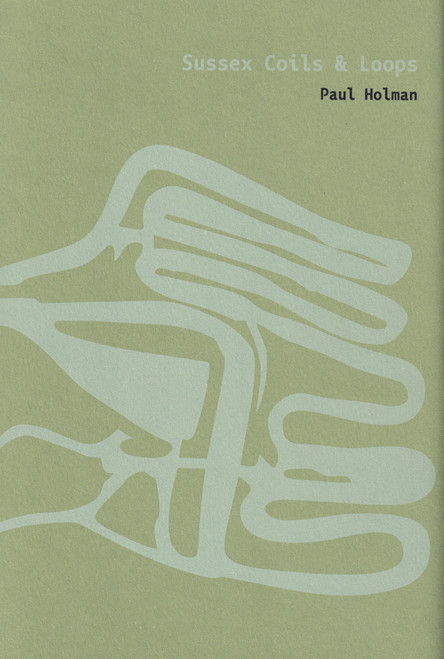
Sussex Coils and Loops
by Paul Holman
“Sussex folk seem ever to have had a leaning towards snaky things.”
Sussex Coils and Loops is a work of parafolklore on the great serpents encountered in the land of south-east England. The book describes a series of ritual actions performed between the winter solstice of 2017 and the summer solstice of 2022 at sites with serpent or dragon legends associated with them.
We explore hidden woods, secret pools and lonely churches, find clues in stained glass windows, graveyards, fading murals, tattered pamphlets and video games. There are hermits and saints, headless horsemen, mighty oaks and giant puddings. Shrines are constructed, encounters logged.
Each generation is seen to have added to the recursive legend, and the sources range from Anglo-Saxon and medieval Latin accounts to contemporary storytellers. All seek to plumb the depthless knucker holes and reveal their great and terrifying wyrms.
In Sussex Coils and Loops, Paul Holman deploys a number of strategies to demonstrate and report on these workings. The writing is in turn experimental, documentary, and scholarly. This is unashamedly contemporary landscape magic.
Holman resists any characterisation of folklore that privileges a notion of authenticity as inherently conservative. Rather, he sees it as a dynamic and unstable process which is constantly taking on provisional, dare we say, snaky, forms
Through its careful scholarship, field investigations, and experiments with form, Sussex Coils and Loops offers a variety of entry points into this living tradition, honouring its unruly, indefatigable nature, and curious to see where it might go next.
____________________________________________________________
Table of Contents
1614
Shrine
Strange, yet now a neighbour to us
The hidden thing, the herdsman, the goad
A daily code, a layered mass
Its gloomy mazes often the theme
A book of Bessie and Sallyann
The double pupil
I saw never fowler wormes
Interview with Jon Williams
The Climping working
Lewinna
Typhon | Delphyne | Python
A final shrine
A serpent or dragon temple
Azimuth fragments
Addenda
____________________________________________________________
Illustrations by Harriet Holman Penney
Standard Hardcover Edition - Limited to 300 copies
176 pages. Bound in chalk white cloth, red foil glyph on front board and titling on spine, green end papers, and dust jacket.
Paperback Edition
176 pages. Sewn paperback, printed on 120 gsm paper.
____________________________________________________________
Press, reviews, endorsements
“This study alone successfully illuminates the long and winding journey of a folk-cultural corpus, as its narratives are embroidered, patched or excised by the vicissitudes of time, fashion, and inclination. It illustrates how folk legends are not inert historical artefacts but living, evolving entities in their own right; initially shaped by, then helping to shape, a specific place, identity and set of customs. These are the things providing a bulwark against cultural homogenisation, and alienation from the land. They should be cherished.”
Mark Nemglan - read the full review here
“I strongly recommend this book […] it’s full of wonders and surprises; a magical book.”
Mike O’Leary, author of Sussex Folk Tales - read the full review here
“… a book treading the path of folklore, pilgrimage and praxis.”
David Wenborn (Dagenham Dave) for The Western Gate - read the full review here
____________________________________________________________
About the Author
Paul Holman is the author of The Memory of the Drift, a shifting but ultimately circular work which was both a record of operations and a process in itself. A new edition, gathering writing made between 1991 and 2017, is in print from Shearsman. Further material from the same project is published in Tara Morgana, from Scarlet Imprint.
Most recently, Holman wrote Sussex Coils and Loops, which documents a series of ritual art actions carried out at sites in South-East England which have serpent and dragon legends associated with them. Artwork and artefacts from the book were exhibited at the Candid Arts Trust in London in 2024.
He has been working intermittently on a side project based around contemporary expressions of the oracular: while some of this material has been separately published, rather more than he intended has been absorbed into the mainstream of his writing. He is a long-standing member of the Field Study mail art group. Much of the material contained in The Memory of the Drift has its origin in Field Study manifestations, which have both supplied an occasion for his work and offered it a testing ground. His website can be found here.