Hermetica I
The Corpus Hermeticum, Asclepius, and Nag Hammadi Hermetica Ordered as a Path of Initiation
by M. David Litwa, PhD
illustrated by José Gabriel Alegría Sabogal
The Hermetic corpus is a spiritual and intellectual treasure stemming from ancient Egyptian sages who could write and think in Greek. Since the Renaissance, this corpus has appeared in an order that doesn’t fit the path of spiritual initiation suggested by the corpus itself. This edition reorders the corpus—including the Latin Asclepius and the Nag Hammadi Hermetica—into four progressing parts: introductory tractates, general discourses, detailed discourses, and revelatory discourses. A focused commentary follows each tractate. The book is written for all lovers of the Hermetica, but in particular for those who are willing, in some sense, to join the way of immortality.
This volume presents the Hermetic writings as a central and enduring current within Western spirituality, born from the encounter between Egyptian religious wisdom and Greek philosophical thought in late antiquity. Composed at a time when traditional cults and forms of knowledge were under threat, the Hermetica preserve a vision of spiritual rebirth, divine knowledge, and inner transformation that continued to shape later philosophical and Christian traditions, often without acknowledgment. These texts are not peripheral speculations but articulate a serious and integrated spiritual worldview aimed at awakening higher consciousness and participation in divine life.
Rather than treating the Hermetica as a loosely assembled anthology or merely as historical documents, this book approaches them as a corpus structured by initiation and spiritual formation. Guided by indications within the texts themselves, the tractates are arranged to reflect a movement from exhortation and preparation, through doctrinal grounding, toward revelatory experience. Reading, in this context, becomes a disciplined engagement—one that ancient readers understood as capable of effecting genuine inner change rather than serving purely intellectual ends.
The Hermetic path presented here resists easy categorisation. It does not collapse into abstract philosophy, nor does it reduce spiritual experience to dogma or belief. Instead, it unfolds in stages, holding together cosmology, ethics, and contemplative practice, and culminating in rebirth and direct vision of the divine realms. Apparent tensions within the corpus—between world-affirmation and renunciation, or between unity and distinction—are shown to reflect different moments within a coherent process of spiritual transformation.
Although grounded in years of careful scholarship and translation, this book is not written for specialists alone. It speaks to readers who wish to understand the historical depth of the Hermetic tradition while remaining attentive to its spiritual demands. For practitioners and academics alike, it offers an invitation to encounter the Hermetica not only as texts to be analysed, but as writings intended to shape perception, practice, and inner life.
____________________________________________________________
Table of Contents
About the Author
Preface
Abbreviations
PART I: Introduction to the Way of Immortality
1. ch 1: The Poimandres of Hermes Thrice Great
2. ch 7: The Greatest Vice among Humans is Ignorance about God
3. ch 6: In God Alone is Goodness, and Nowhere Else
4. ch 4: Hermes to Tat: The Mixing Bowl
PART II: General Discourses
5. ch 3: A Sacred Discourse of Hermes (On Creation)
6. ch 14: (On God as Creator)
7. ch 16: Definitions of Asclepius to King Ammon (On the Sun as Creator and On Daimones)
8. ch 2: General Discourse of Hermes to <Asclepius> (On Space)
9. ch 8: No Being is Destroyed, though Deceived People Call Changes “Losses” and “Deaths”
10. ch 17: (On Divine Images)
11. (The Asclepius or Complete Discourse) A Sacred Volume of Hermes Thrice Great Spoken to Asclepius
12. ch 9: On Thought and Sensation
PART III: Detailed Discourses
13. ch 12: On Common Consciousness
14. ch 11: Higher Consciousness to Hermes
15. ch 5: Hermes to his Son Tat: God Invisible is Most Visible
16. ch 10: The Key of Hermes Thrice Great
PART IV: Revelatory Discourses
17. ch 13: Discourse of Hermes Thrice Great to His Son Tat on a Mountain, a Hidden Discourse on Rebirth and the Pledge of Silence
18. <The Eighth Reveals the Ninth>
19. The Prayer of Thanksgiving
Appendix
20. ch 18: (On Music and the Praise of Kings)
PART V: Essays
Hermetic Spirituality: The Sixteen Principles
Hermetic Deification
Bibliography
Index
____________________________________________________________
Hardcover Ltd. Edition - The Definitive Edition: First Print - Limited to 600 copies
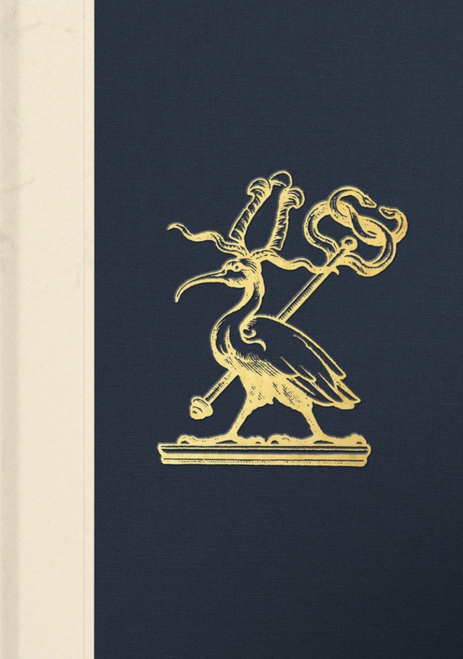
248 pages. Hermetica I is presented as a finely crafted hardback volume, quarter-bound in Ratchford Windsor (Warwick) book cloth & Elefantenhaut High White paper, section-sewn and finished with a rounded hollow spine for durability and elegance. The pages are printed in black ink on 140 gsm Arena Rough Natural paper and complemented by colour endpapers featuring distinct designs at the front and back. Finishing details include gold foil blocking on the spine and front cover, a blind debossed line on the front, gold head and tail bands, and a matching gold bookmark ribbon. The book is housed in a 160 gsm Golden Star K Extra White dust jacket with french-flaps, UV printed in black, and all materials used are FSC MIX certified.
ISBN: 978-1-989339-27-5
____________________________________________________________
About the Author
Dr. M. David Litwa’s career began with a monograph on deification (becoming god) as seen through the lens of the Pauline writings (We Are Being Transformed, 2012). In 2013, he offered a general introduction to deification in Western culture from the Pharaohs to modern Transhumanists. Then in 2016, he focused on the politics and literature of self-deification (Desiring Divinity). He has twice engaged gospel literature as a witness to Jesus’s literary deification (Iesus Deus, 2014) and to a particular historiographical genre (How the Gospels Became History, 2019). A fascination with alternative Christian movements inspired him to edit and translate the anonymous Refutation of All Heresies (2016). After that came the annotated translation of important Hermetic testimonial and fragments (Hermetica II, 2018). Litwa has finished a project on angelification traditions in Hellenic and Christian literature (Posthuman Transformation, 2021). He has published history of alternative Christian movements in the second-century CE (Found Christianities). A full book on one of these movements, the Carpocratians, came out in 2022. It contains the first ever fully commentary on "Secret Mark." Dr. Litwa's most popular book, The Evil Creator (2021), tells the secret history of how Christians like Marcion came to view the creator as evil. Late Revelations is a short, accessible argument for a late date of the final form of the Gospels and Acts. Hermetica I is a new translation of the Corpus Hermeticum based on a better edition of the Greek text.
About the Artist
José Gabriel Alegría Sabogal is an artist and art historian, born in Berlin and raised in Lima, Perú. He is currently completing his doctoral research with the Max Planck Institute for Art History, Bibliotheca Hertziana, Rome. His research interests include religious iconography and Sanskrit philology, the comparative study of religion, and Gnosticism in particular. His visual work makes use of the line technique found in renaissance copper plate engraving but applied to drawings. Both the themes and their treatment José explores are essentially anachronistic and follow the initiative of developing a symbolic language that aspires to a timeless nature.