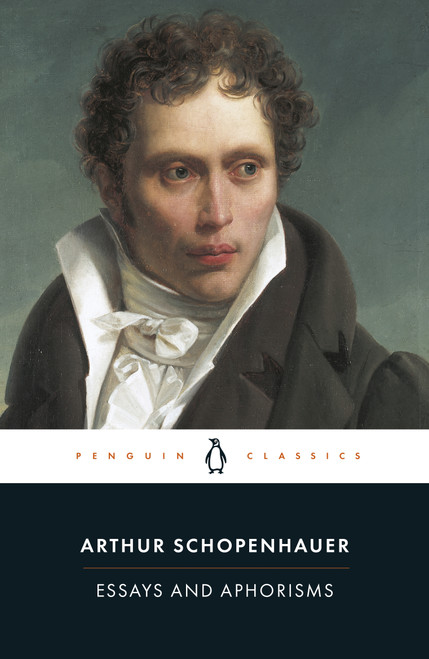
Essays and Aphorisms
A Polemic
by Arthur Schopenhauer
A collection of Schopenhauer's powerful and inventive philosophy
One of the greatest philosophers of the nineteenth century, Schopenhauer believed that human action is determined not by reason but by 'will' - the blind and irrational desire for physical existence. This selection of his writings on religion, ethics, politics, women, suicide, books and many other themes is taken from Schopenhauer's last work, Parerga and Paralipomena, which he published in 1851. These pieces depict humanity as locked in a struggle beyond good and evil, and each individual absolutely free within a Godless world, in which art, morality and self-awareness are our only salvation. This innovative - and pessimistic - view has proved powerfully influential upon philosophy and art, directly affecting the work of Nietzsche, Wittgenstein and Wagner among others.
____________________________________________________________
Table of Contents
Introduction
ESSAYS
On the Suffering of the World
On the Vanity of Existence
On the Antithesis of Thing in Itself and Appearance
On Affirmation and Denial of the Will to Live
On the Indestructibility of our Essential Being by Death
On Suicide
On Women
On Thinking for Yourself
On Religion: a Dialogue
APHORISMS
On Philosophy and the Intellect
On Ethics
On Law and Politics
On Aesthetics
On Psychology
On Religion
On Books and Writing
On Various Subjects
List of Correspondences
Chronology
Further Reading
____________________________________________________________
Paperback Edition
256 pages. Printed card cover.
ISBN: 9780140442274
____________________________________________________________
Press, reviews, endorsements
“Schopenhauer was the first to speak of the suffering of the world, which visibly and glaringly surrounds us”
Carl Jung
____________________________________________________________
About the Author
Arthur Schopenhauer (1788 – 1860), also known as the “Philosopher of Pessimism”, was a German philosopher and writer. He is known for his 1818 work The World as Will and Representation (expanded in 1844), which characterises the phenomenal world as the manifestation of a blind and irrational noumenal will. Building on the transcendental idealism of Immanuel Kant, Schopenhauer developed an atheistic, metaphysical and ethical system that rejected the contemporaneous ideas of German idealism.
Schopenhauer was among the first philosophers in the Western tradition to share and affirm significant tenets of Indian philosophy, such as asceticism, denial of the self, and the notion of the world-as-appearance. His work has been described as an exemplary manifestation of philosophical pessimism. Though his work failed to garner substantial attention during his lifetime, he had a posthumous impact across various disciplines, including philosophy, literature, and science. His writing on aesthetics, morality and psychology has influenced many thinkers and artists.