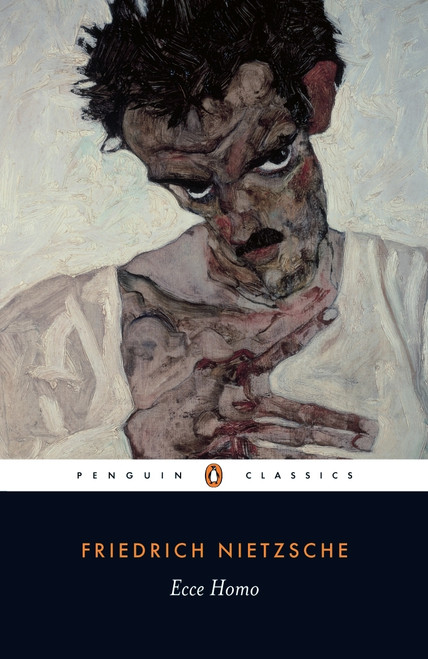
Ecce Homo
How One Becomes What One Is
by Friedrich Nietzsche
“I am not a man, I am dynamite.”
In late 1888, only weeks before his final collapse into madness, Nietzsche set out to compose his autobiography, and Ecce Homo remains one of the most intriguing yet bizarre examples of the genre ever written. In this extraordinary work Nietzsche traces his life, work and development as a philosopher, examines the heroes he has identified with, struggled against and then overcome - Schopenhauer, Wagner, Socrates, Christ - and predicts the cataclysmic impact of his 'forthcoming revelation of all values'. Both self-celebrating and self-mocking, penetrating and strange, Ecce Homo gives the final, definitive expression to Nietzsche's main beliefs and is in every way his last testament.
____________________________________________________________
Table of Contents
INTRODUCTION
NOTE ON THE TEXT
CHRONOLOGY
FURTHER READING
ECCE HOMO
HOW ONE BECOMES WHAT ONE IS
Foreword
On this perfect day…
Why I am So Wise
Why I am So Clever
Why I Write Such Good Books
The Birth of Tragedy
The Untimely Essays
Human, All Too Human
Daybreak
The Gay Science
Thus Spoke Zarathustra
Beyond Good and Evil
Genealogy of Morals
Twilight of the Idols
The Wagner Case
Why I am a Destiny
NOTES
____________________________________________________________
Paperback Edition
144 pages. Printed card cover.
ISBN: 9780140445152
____________________________________________________________
Press, reviews, endorsements
“Enigmatic, vatic, emphatic, passionate, often breathtakingly insightful, his works together make a unique statement in the literature of European ideas.”
A.C. Grayling
____________________________________________________________
About the Author
The late Friedrich Nietzsche (1844-1900) was a German classical scholar, philosopher, and critic of culture, who became one of the most influential of all modern thinkers. His attempts to unmask the motives that underlie traditional Western religion, morality, and philosophy deeply affected generations of theologians, philosophers, psychologists, poets, novelists, and playwrights. He thought through the consequences of the triumph of the Enlightenment’s secularism—expressed in his observation that “God is dead”—in a way that determined the agenda for many of Europe’s most-celebrated intellectuals after his death. Although he was an ardent foe of nationalism, antisemitism, and power politics, his name was later invoked by fascists to advance the very things he loathed. For further reading on the misappropriation of Nietzsche’s work, read here.