An Excellent Booke of the Arte of Magicke
The Magical Works of Humphrey Gilbert and John Davis
edited and introduced by Phil Legard
supplementary essays by Alexander Cummins
foreword by Dan Harms
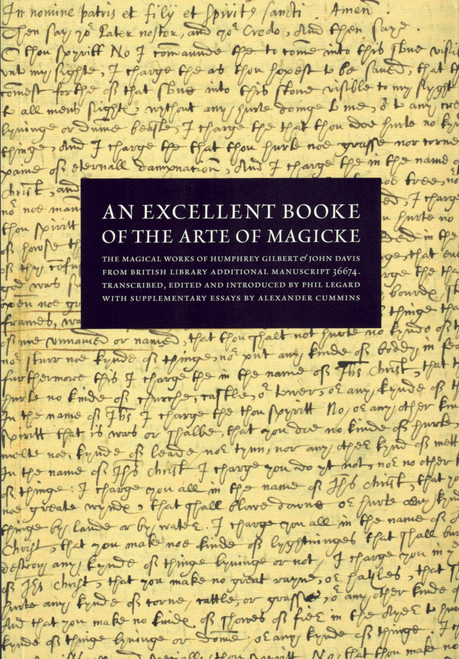
An Excellent Booke of the Arte of Magicke: The Magical Works of Humphrey Gilbert and John Davis, transcribed from British Library Additional manuscript 36674, edited and introduced by Phil Legard, with supplementary essays by Alexander Cummins, and a foreword by Dan Harms.
The first part of the book, Texts, opens with a colour facsimile of ff.47r–62v from Add. ms. 36674, known as the Excellent Booke and Visions, followed by modernised and diplomatic transcriptions.
The magical experiments conducted by Elizabethan explorer, soldier and courtier Humphrey Gilbert, along with his scryer John Davis, during the spring of 1567 are notable for their forceful methods and stripped down Protestant ritual. The spirits are called into a ‘crystal stone’ by way of a large number of conjurations, charges, constraints, curses and bonds. The work includes the practical conjuration of Bleth, Aosal, Assassel (Azazel) and the four demon kings of the winds, namely Oriens, Amaimon, Paimon and Aegyn. It is evidently based on an older text or texts, adapted to the Protestant outlook of the period, and has also been supplemented with revelations and guidance received first-hand by Gilbert and Davis over the course of its composition. As such, the texts are a rare example of the poiesis, or coming-together, of a ritual magic book. The texts attest to the continuity of medieval ritual magic into the early modern period.
Visions is a record of visions in the crystal, detailing events which took place before, during and after the composition of the Excellent Booke. In the course of this work, the master – Humphrey Gilbert – and scryer – John Davis – converse with a wide-range of spirits as well as religious and occult personalities, including Assasel, Solomon, Roger Bacon, Cornelius Agrippa and four angelic evangelists. The pair experience a series of remarkable sights concealed behind the seven-keyholed door of the house of Solomon. On occasion the visions bled into the waking world in encounters with great demonic dogs and the physical manifestation of the prophet Job.
The Excellent Booke and Visions are, as Legard writes in his Preface, ‘unique documents of sixteenth century magical practice: ones that deserve to be widely read and studied by scholars and practitioners alike since they preserve a detailed account of both the making and the use of a grimoire.’ A book of particular note to those interested in Azazel, the fallen angel and necromantic traditions, students of the grimoires and the practical workings of dirty medieval magic.
Appended to the Excellent Booke are three further, related manuscript transcriptions, the necromantic graveyard ritual in Experiments of Azasel, Ancor, Anycor and Analos, from Illinois Pre-1650 ms. 0102, the scrying procedure of An Experiment of Bleth, from Sloane 3824, and the necromantic and treasure hunting rites of Related Experiments, from Case ms. 5017.
In the second part of the book, Contexts, Dr Alexander Cummins provides a trilogy of essays. He first surveys early modern necromancy, its tools and techniques in their historical setting. He then discusses scrying techniques in depth, with reference to Artephius, Dee and Kelley, Aubrey, Lilly, Forman et al. He concludes with a discussion of tutelary shades, and the learning of magic from dead magicians, whether Solomon, Adam, Cornelius Agrippa or Roger Bacon. Thus armed, the appropriately black-clad reader can engage with the Excellent Booke as a practical grimoire of the necromantic art.
Phil Legard draws the book to a close with an essay on the phenomenology of the necromantic workings of Gilbert and Davis which provides an open door for both practitioners and academics through which to pursue the performative and affective practice of magic.
____________________________________________________________
Table of Contents
Acknowledgments
Foreword: The Best Book That Ever Was?
Preface
Visionary Magicke: Humphrey Gilbert and the Poiesis of a Grimoire
1 Texts
Facsimile
A Note on the Transcriptions
An Excellent Booke of the Arte of Magicke
Modernised Transcription
Diplomatic Transcription
Visions
Modernised Transcription
Diplomatic Transcription
Experiments of Azasel, Ancor, Anycor and Analos, from Illinois Pre-1650 MS 0102
Modernised Transcription
Diplomatic Transcription
An Experiment of Bleth, from Sloane 3824
Modernised Transcription
Diplomatic Transcription
Related Experiments, from Case MS 5017
Modernised Transcription
Diplomatic Transcription
2 Contexts
Sorcerous Significances of the Excellent Booke and its Visions
By Stone and By Call: Medieval and Early Modern Evocatory Scrying
Tutelary Shades
Good Books to Call By: Text, Speech and Materiality in the Necromantic Workings of Humphrey Gilbert and John Davis
Bibliography
____________________________________________________________
Colour facsimile of British Library Additional ms. 36674
Illustration of the Tree of Crystal by Sin Eater
Paperback Edition
368 pages. Sewn paperback, printed on 150 gsm paper.
____________________________________________________________
About the Editor
Phil Legard is an author, scholar and musician, exploring the presence of esoteric and occult thought in the domains of creativity, culture and politics. His works on magic include ‘Wise Hermes, Black Venus’ (Mandragora, Scarlet Imprint), The Mirror of Elicona (Hadean Press), ‘The Magic of Tuba Veneris’ (Libellus Veneri Nigro Sacer, Trident Books), and ‘The Cunning-Folk’s Chrismon?’ (Enquiring Eye, Museum of Witchcraft and Magic). An Excellent Booke of the Arte of Magicke, co-authored with Al Cummins, is his first book-length publication.
Phil’s current musical project, Hawthonn, with Layla Legard, released the acclaimed Red Goddess (of this men shall know nothing) in 2018 on Ba Da Bing Records. Hawthonn has thus far explored themes such as edgeland herbalism, oneiric eroticism, and menstrual mysteries (in the tradition of Penelope Shuttle and Peter Redgrove). Hawthonn is also pursuing a critical re-evaluation of the assumptions underlying Western esotericism and paganism, and presented work on this topic in the lecture on ‘Critical Magick’ at Strange Attractor’s Towards a Progressive Magick event, co-presented with Dr Amy Hale.
As an academic, Phil is currently a senior lecturer with the Leeds School of Art, based at Leeds Beckett University. He teaches music production and technology at undergraduate and masters level, and is currently engaged in PhD research on the role of ‘occulture’ in 21st century underground music. He has presented work at conferences including The Alchemical Landscape (Cambridge University), Listen to the Voice of Fire (Bangor University), Uncanny Landscapes (Royal Holloway) and Exploring the Extraordinary.