A Vision
by W. B. Yeats
And then he laughed to think that what seemed hard
Should be so simple—a bat rose from the hazels
And circled round him with its squeaky cry,
The light in the tower window was put out.
A Vision is the philosophical heart of all W.B. Yeats’ work during the 1920s and 1930s, lending theme and structure to Michael Robartes and the Dancer, The Tower, and The Winding Stair and Other Poems. Its introduction tells the story of how characters from his earlier occult fiction - Michael Robartes, Owen Aherne - discover an ancient method for reckoning human identity and destiny according to the phases of the Moon. Yeats then expounds this philosophy, largely through his commentary on a succession of enigmatic figures and diagrams.
As Yeats admits in the 1937 edition, he spun this legend to conceal the truth. In fact, the philosophy is drawn from the trance mediumship and automatic writings of his wife, Georgie Hyde-Lees between 1917 and the first publication of A Vision in 1925.
A Vision is in many respects comparable to that other 20th-century work of visionary poetic myth, The White Goddess; like Robert Graves, Yeats is allowing his pen to be guided as much as he is struggling to make sense of the revelation.
____________________________________________________________
Table of Contents
A PACKET FOR EZRA POUND
Rapallo
Introduction to “A Vision”
To Ezra Pound
STORIES OF MICHAEL ROBARTES AND HIS FRIENDS: AN EXTRACT FROM A RECORD MADE BY HIS PUPILS
THE PHASES OF THE MOON
BOOK I: THE GREAT WHEEL
Part I: The Principal Symbol
Part II: Examination of the Wheel
Part III: The Twenty-Eight Incarnations
BOOK II: THE COMPLETED SYMBOL
BOOK III: THE SOUL IN JUDGEMENT
BOOK IV: THE GREAT YEAR OF THE ANCIENTS
BOOK V: DOVE OR SWAN
ALL SOUL’S NIGHT: AN EPILOGUE
____________________________________________________________
Hardcover Edition
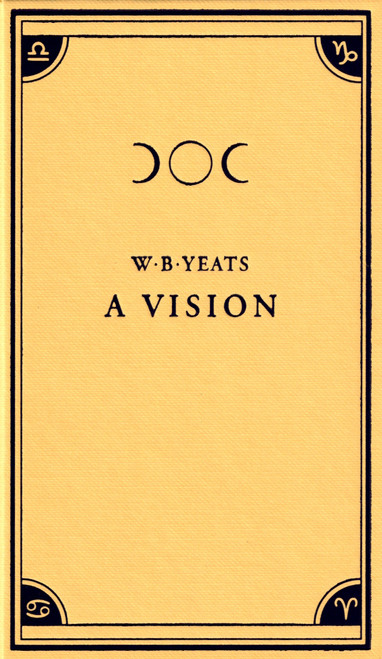
507 pages. Hardcover bound in Yellow Geltex. 120g black endpapers. Printed on 115g wood-free, age-resistant Cream paper. Sewn book block, black ribbon bookmark and headbands.
____________________________________________________________
About the Author
The late William Butler Yeats (1865–1939) was an Irish poet, dramatist, writer and literary critic who was one of the foremost figures of 20th-century literature. He was a driving force behind the Irish Literary Revival and, along with John Millington Synge and Lady Gregory, founded the Abbey Theatre, serving as its chief during its early years. He was awarded the 1923 Nobel Prize in Literature and later served two terms as a Senator of the Irish Free State.
Yeats had a lifelong interest in mysticism, spiritualism, occultism and astrology. During 1885, Yeats was involved in the formation of the Dublin Hermetic Order, and he was was admitted into the Hermetic Order of the Golden Dawn in 1890. His mystical interests—also inspired by a study of Hinduism, under the Theosophist Mohini Chatterjee, and the occult—formed much of the basis of his late poetry. In 1892 he wrote: "If I had not made magic my constant study I could not have written a single word of my Blake book, nor would The Countess Kathleen ever have come to exist. The mystical life is the centre of all that I do and all that I think and all that I write”.