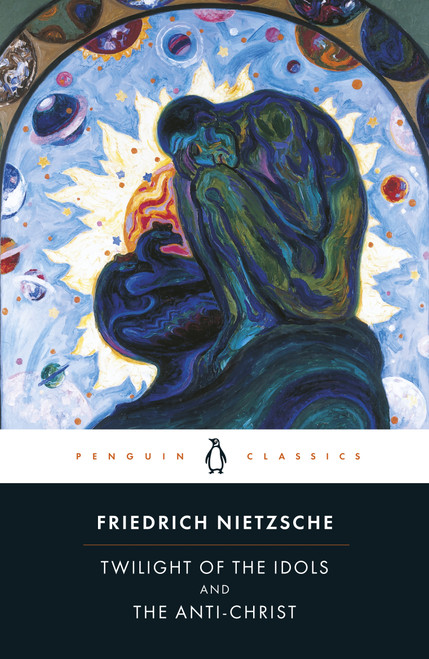
Twilight of the Idols and The Anti-Christ
by Friedrich Nietzsche
In two of his final and most devastating works, Nietzsche, at his most fierce and precise, offers a powerful attack on the morality and the beliefs of his time.
Twilight of the Idols is a 'grand declaration of war' on reason, psychology and theology, which combines highly charged personal attacks on his contemporaries (in particular Hegel, Kant and Schopenhauer) with a lightning tour of his own philosophy. It also paves the way for The Anti-Christ, Nietzsche's final assault on institutional Christianity, in which he identifies himself with the 'Dionysian' artist and confronts Christ: the only opponent he feels worthy of him.
Both works show Nietzsche lashing out at self-deception, astounded at how often morality is based on vengefulness and resentment. Both reveal a profound understanding of human mean-spiritedness which still cannot destroy the underlying optimism of Nietzsche, the supreme affirmer among the great philosophers.
____________________________________________________________
Table of Contents
Introduction
Translator’s Note
Further Reading
TWILIGHT OF THE IDOLS
Or, How to Philosophize with a Hammer
Foreword
Maxims and Arrows
The Problem of Socrates
‘Reason’ in Philosophy
How the ‘Real World’ at last Became a Myth
Morality as Anti-Nature
The Four Great Errors
The ‘Improvers’ of Mankind
What the Germans Lack
Expeditions of an Untimely Man
What I Owe to the Ancients
The Hammer Speaks
THE ANTI-CHRIST
Foreword
The Anti-Christ
Glossary of Names
Chronology
____________________________________________________________
Paperback Edition
224 pages. Printed card cover.
ISBN: 9780140445145
____________________________________________________________
Press, reviews, endorsements
“Enigmatic, vatic, emphatic, passionate, often breathtakingly insightful, his works together make a unique statement in the literature of European ideas.”
A.C. Grayling
____________________________________________________________
About the Author
The late Friedrich Nietzsche (1844-1900) was a German classical scholar, philosopher, and critic of culture, who became one of the most influential of all modern thinkers. His attempts to unmask the motives that underlie traditional Western religion, morality, and philosophy deeply affected generations of theologians, philosophers, psychologists, poets, novelists, and playwrights. He thought through the consequences of the triumph of the Enlightenment’s secularism—expressed in his observation that “God is dead”—in a way that determined the agenda for many of Europe’s most-celebrated intellectuals after his death. Although he was an ardent foe of nationalism, antisemitism, and power politics, his name was later invoked by fascists to advance the very things he loathed. For further reading on the misappropriation of Nietzsche’s work, read here.