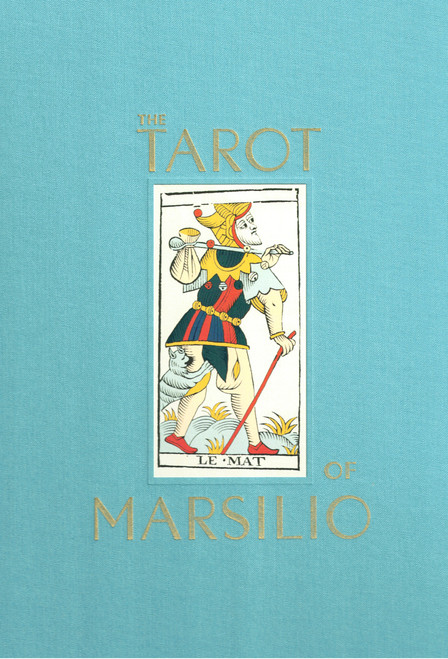
The Tarot of Marsilio
Volume I · Down Here
by Christophe Poncet
Down Here is the first of a meticulously researched and lavishly illustrated three volume work, The Tarot of Marsilio by Christophe Poncet; a landmark inquiry into the origins of the Tarot de Marseille. Against the prevalent view in the academy – that the tarot was never used, before the 18th century, for anything other than card games – Poncet argues that the Tarot de Marseille is a work of esoteric philosophy hidden in plain sight.
Through a careful analysis of artworks, philosophical texts, and the imagery and symbolism of the cards, Poncet places and dates the deck to Florence in the 1470s. Marsilio Ficino, translator of the Corpus Hermeticum and the complete works of Plato, is identified as the likely mastermind behind this tarot. In this first volume, the imagery and meaning of the Chariot, the Devil, the Lovers, Strength, the Hermit, the House of God, Arcanum XIII and the Fool are explored.
As readers of Two Esoteric Tarots will know, Poncet’s investigation is comparable to that of Peter Mark Adams in The Game of Saturn, shedding new light on heterodox thought in the Renaissance.
Christophe Poncet has been on a decades long quest to discover the truth about the Tarot de Marseille and the esoteric ideas encoded in the cards. The Tarot of Marsilio takes us on an extraordinary journey of discovery, from a lost masterpiece of Botticelli in a ruined castle, through the stacks of the Vatican library, artist’s sketchbooks, and works in the collections of the Louvre, the British Museum, and the National Gallery. Poncet brings us into the hermetic thought-world of the circle around the brilliant polymath Marsilio Ficino.
For the tarot reader and occultist, this work opens up a profound understanding of the cards, their history and the context of their creation. With these keys we can read the visual language of the trumps as they were intended, and play the game of Western esotericism at a deeper level. Whether enhancing our divinations or stimulating the practice of talismanic and image magic, Poncet changes forever our understanding of the most archetypal and iconic tarot deck.
____________________________________________________________
Table of Contents
Introduction
I A Child of Mercury
II The Chariot’s Journey
III Plato’s Chariot
IV The Games of the Academy
V Psychology of the Chariot
VI A Hint of Botticelli
VII The Art of Botticelli and the Laws of Physics
VIII A Surprise in Esztergom
IX The Sword and the Scales
X At the Intersection of the Diagonals
XI Woe Betide the Defeated
XII Inside Plato’s Cave
XIII A Certain Felice Feliciano
XIV A Treasure in the Vatican Library
XV The Judgement of Philebus
XVI The Young Man and the Angel
XVII Two Venuses
XVIII Anatomy of a Chimera
XIX The Beasts Within
XX The Man with the Lamp
XXI In Search of the Third Eye
XXII The Triumph of Life
XXIII The Pilgrim Fool
XXIV The Oar, the Spade, and the Gigantic Spoon
XXV The Tower of Men and the House of God
To Be Continued
Bibliography
Indexes
____________________________________________________________
Large format, full-colour illustrations throughout
Standard Hardcover Edition - limited to 875 copies
280 pages. Bound in sky blue cloth stamped in gold on spine and front, and with an onlay illustration of The Fool. Blue and white head and tail bands. Carmine endpapers and ribbon. Printed in colour on premium 150 gsm paper.
____________________________________________________________
Press, reviews, endorsements
“The Tarot of Marsilio: An inquiry into the origins of the Tarot de Marseille. Volume 1 - Down Here sets a new benchmark in the iconographic and iconological study of the historical tarot; and in doing so, it decisively revises both the developmental history and significance of the cards. As we have come to expect from Scarlet Imprint, the production values realised in this work are of the highest order, enjoying a level of design and colour illustration that make it a work of elegance and enduring beauty… I am confident that this opus is destined to be one of the seminal works of modern tarot scholarship and to be an essential addition to the library of all who are interested in the origins, history, iconography and iconology of the historical tarot.”
Peter Mark Adams for Paralibrum - read the full review here
“Christophe Poncet’s recent publication of the first volume of The Tarot of Marsilio reopens the debate about an esoteric plan and vision that may underline the tarot of Marseille type. He brings the impressive understanding of many years of research, all coming into fruition in this beautiful volume freshly printed by Scarlet Imprint with a wealth of illustrations and of key source texts rarely translated in English.”
Nicolas Lecerf for Via-Hygeia - read the full review here
Interview with Christophe Poncet by the Perseus Arcane Academy - read it here
Interview with Christophe Poncet on the Arcanvm channel - watch on YouTube here
____________________________________________________________
About the Author
At the crossroads between occult and human sciences, philosophy, iconology and the theurgic art of talismans, Christophe Poncet’s research on the tarot de Marseille’s arcana sets the theatre of an initiatory quest.
It all started as a fantasy tale: on his 19th birthday his girlfriend offered him a wicked pack of cards. A tarot de Marseille deck.
Intrigued by the dynamic density of the symbols sedimented in the images, as an accretion of geological strata, he discovered a strange and foreign language that draws its power from its combinatory plasticity. He then realised that to understand what the cards had to say, one would need to find out from what they were made.
Thus began the allegorical adventure: just like the Fool, the pilgrim who knows not where he is heading to, Poncet gets off the beaten track of the abundant lore on the mythical origins of the tarot and starts afresh from a rigorous analysis of the costumes represented in the card’s figures. This leads him to a precise dating and localisation of the tarot de Marseille’s origins: Florence circa 1470, the cradle of the Italian Renaissance.
In parallel with this iconographical inquiry, as he was reading Plato’s dialogues, Poncet realised that several arcana stage famous Platonic myths, like the chariot of the soul or the allegory of the cave: the figures he had been studying were suddenly revealing their hidden density.
Beyond art history and its layer of appropriations and influences, came up the inner machinery of a philosophical theatre of memory in which images do not just represent but act as vectors of an occult thought process.
At the intersection between Florence and Platonic mythology, an unexpected protagonist showed up: Marsilio Ficino, philosopher, mage, and astrologist, the first translator of Plato’s complete works and of the Corpus Hermeticum, and the savant who probably lent his first name to the tarot de Marseille.
Irrigating western thought with the philosophical mysteries of Antiquity, to which his commentaries add a twist of his own, Ficino’s works fuelled an unprecedented speculative and artistic enthusiasm, which strongly contributed to the transmutation of the scholastic thought of the Middle Ages into a Renaissance of spirit and knowledge.
Just like its subject, Poncet’s research deploys a multi-layered ars combinatoria: at first, with iconological precision, it investigates the original texts that inspired the artists’ images; then the philosophical vision, anachronic in the way it reappears and turns back to life in the traditional world of art representations, awakens the iconic and magical dimension of performative images. This dimension, today as in the Renaissance, retains intact the charm of a universal and visionary use of the cards.
Poncet’s research has led him to produce a documentary film broadcasted internationally, The Mysteries of the Tarot of Marseille, to publish a book on Sandro Botticelli’s Primavera and the Lovers card of the tarot de Marseille, Le Choix de Laurent, translated into Italian and Japanese, and many articles in academic journals on the tarot, on Botticelli and on Ficino.