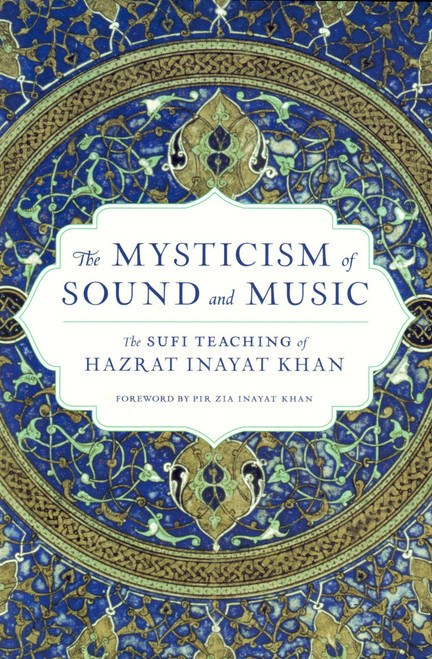
The Mysticism of Sound and Music
The Sufi Teaching of Hazrat Inayat Khan
by Hazrat Inayat Khan
foreword by Pir Zia Inayat Khan
"By the end, the reader will be hard-pressed to deny the truth of the author's words when he says that music is the miniature of life's harmony, the language of beauty and the soul, the basis of the whole creation, and the nearest way to God."
- from the foreword
Perfect for musicians and spiritual practitioners alike, this modern classic of Universal Sufism explores the mystical dimensions of music—and the musical dimensions of mysticism.
The first teacher to bring Islamic mysticism to the West presents music’s divine nature and its connection to our daily lives in this poetic classic of Sufi literature.
Music, according to Sufi teaching, is really a small expression of the overwhelming and perfect harmony of the whole universe—and that is the secret of its amazing power to move us. The Indian Sufi master Hazrat Inayat Khan, the first teacher to bring the Islamic mystical tradition to the West, was an accomplished musician himself. His lucid exposition of music's divine nature has become a modern classic, beloved not only by those interested in Sufism but by musicians of all kinds.
____________________________________________________________
Table of Contents
Foreword to the 2022 Edition by Pir Zia Inayat Khan
Preface
Prologue
Music
Music
Esoteric Music
The Music of the Spheres
The Mysticism of Sound
The Mystery of Sound
The Mystery of Color and Sound
The Spiritual Significance of Color and Sound
The Ancient Music
The Divinity of Indian Music
The Use Made of Music by the Sufis of the Chishti Order
The Use Made of Music by the Dancing Dervishes
The Science and Art of Hindu Music
The Connection between Dance and Music
Rhythm
The Vina
The Manifestation of Sound on the Physical Sphere
The Effect of Sound on the Physical Body
The Voice
The Influence of Music upon the Character of Man
The Psychological Influence of Music
The Healing Power of Music
Spiritual Attainment by the Aid of Music
Aphorisms
Sayings of Hazrat Inayat Khan
The Mysticism of Sound
The Silent Life
Vibrations
Harmony
Name
Form
Rhythm
Music
Abstract Sound
Cosmic Language
Voices
Impressions
The Magnetism of Beings and Objects
The Influence of Works of Art
The Life of Thought
The Form of Thought
Memory
Will
Reason
The Ego
Mind and Heart
Intuition and Dream
Inspiration
The Power of the Word
The Power of the Word
The Power of the Sacred Word
The Word That Was Lost
Cosmic Language
The Word
The Value of Repetition and Reflection
Phrases to Be Repeated
Inayat Khan’s Sentences for Repetition
Notes
List of Source Lectures and Articles
Index
Also by Hazrat Inayat Khan
____________________________________________________________
Paperback Edition
416 pages. Printed card cover.
ISBN: 9781611809961
____________________________________________________________
Press, reviews, endorsements
"Inayat Khan says that music is the 'picture of our Beloved' and then draws the picture stroke by stroke from every angle and plane until we see it. He is the only holy man I know who delivers an authentic and inclusive spiritual message from a musical sensibility. He does this rigorously, poetically and spontaneously, until we perceive our own actions as music. Open to any line on any page: you will be opened."
W. A. Mathieu, author of The Listening Book and The Musical Life
"A powerful book of mystical insight for people of all traditions."
Monos
"Inayat Khan brought one of the strongest and sweetest lineages from India to the West: the music and open heart of Sufism as it blends with Persian poetry and Western intellect. He is a source and a great joy."
Coleman Barks, author of Open Secret and The Essential Rumi
____________________________________________________________
About the Author
The late Inayat Khan Rehmat Khan (1882–1927), known as Hazrat Inayat Khan, was an Indian professor of musicology, singer, exponent of the sarasvati vina, poet, philosopher, writer, and pioneer of the transmission of Sufism to the West. At the urging of his students, and on the basis of his ancestral Sufi tradition and four-fold training and authorisation at the hands of Sayyid Abu Hashim Madani (d. 1907) of Hyderabad, he established an order of Sufism (The Sufi Order) in London in 1914. By the time of his death in 1927, centres had been established throughout Europe and North America, and multiple volumes of his teachings had been published.