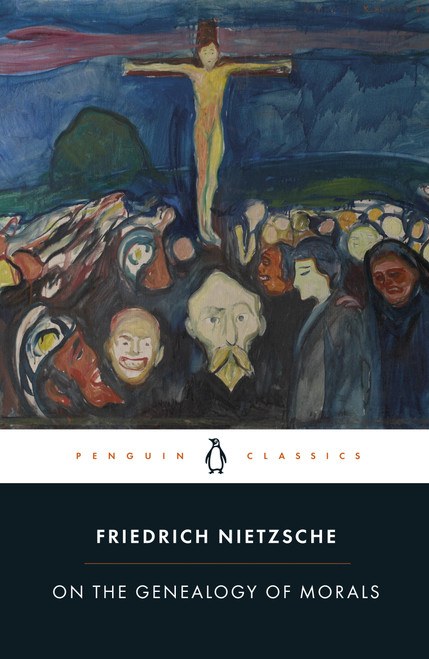
On the Genealogy of Morals
A Polemic
by Friedrich Nietzsche
The companion book to Beyond Good and Evil, the three essays included here offer vital insights into Nietzsche's theories of morality and human psychology
On the Genealogy of Morals explores issues at the very core of human nature in three powerful essays. Here, Nietzsche dissects the basic concepts of ‘good’, ‘bad’ and ‘evil’, going on to examine humankind’s transformation from barbarous creatures into civilised beings who can feel remorse, regret, pit and compassion but, in the process, destroy instinct and freedom. Nietzsche asks why the virtues of poverty, humility and chastity have become so central to religion, even when they deny vitality and life itself. Daring to expose uncomfortable truths, this brilliant polemic provides startling insights into our complex psychology.
____________________________________________________________
Table of Contents
Chronology
Introduction
Note on the Text and Translation
Further Reading
ON THE GENEALOGY OF MORALS
Preface
First Essay: ‘Good and Evil’, ‘Good and Bad’
Second Essay: ‘Guilt’, ‘Bad Conscience’ and Related Matters
Third Essay: What Do Ascetic Ideals Mean?
Notes
____________________________________________________________
Paperback Edition
352 pages. Printed card cover.
ISBN: 9780140441185
____________________________________________________________
Press, reviews, endorsements
“Enigmatic, vatic, emphatic, passionate, often breathtakingly insightful, his works together make a unique statement in the literature of European ideas.”
A.C. Grayling
____________________________________________________________
About the Author
The late Friedrich Nietzsche (1844-1900) was a German classical scholar, philosopher, and critic of culture, who became one of the most influential of all modern thinkers. His attempts to unmask the motives that underlie traditional Western religion, morality, and philosophy deeply affected generations of theologians, philosophers, psychologists, poets, novelists, and playwrights. He thought through the consequences of the triumph of the Enlightenment’s secularism—expressed in his observation that “God is dead”—in a way that determined the agenda for many of Europe’s most-celebrated intellectuals after his death. Although he was an ardent foe of nationalism, antisemitism, and power politics, his name was later invoked by fascists to advance the very things he loathed. For further reading on the misappropriation of Nietzsche’s work, read here.