


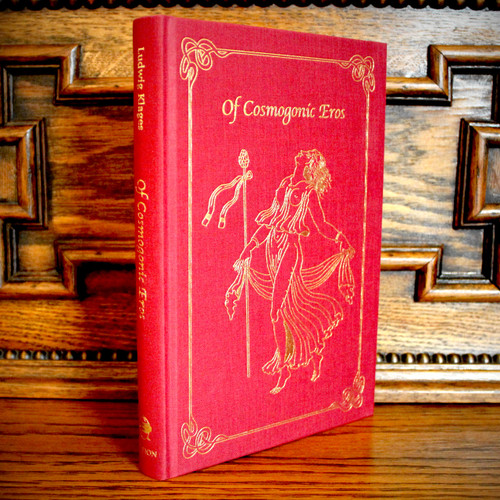
Of Cosmogonic Eros
(Revised 2nd Edition)
by Ludwig Klages
This is the first-ever English translation of one of the most important metaphysical works of the 20th century: Of Cosmogonic Eros by the German visionary Ludwig Klages. This monograph is dedicated entirely to an in-depth examination of the mysteries of Eros and the most powerful forms of ecstasy. Here, Klages presents a pandaemonic vision of becoming which is inextricably linked to an Eros whose elemental power shatters everyday consciousness and mates the individual to the secrets of the cosmos. The author seeks to restore Eros to his true status and function by carefully distilling his essence against all falsifications and distortions. Showing how Eros is related to Thanatos and integral to every true cultus of the dead and ancestral worship, Klages leaves no doubt that only the Eroto-Gnostic holds the keys to authentic Life and the daemonic empowerment of the Cosmos.
Of Cosmogonic Eros is an indispensable work for anyone seeking a deeper understanding of the nature of Eros and ecstasies and the metaphysical conflicts we face in modern times. For researchers and practitioners of Esoteric Traditions and Eroto-Magical systems of spirituality, this book must be considered a treasure chest of insights and knowledge. It is a true rune of an Eros of whom Klages says that:
“He can be roused while awake as if in the most stupefying dream. He celebrates his orgies beneath the breeze of spring storms, in the light of a star-studded heaven, in a hailstone shower, on a flaming mountain ridge, in the raging surf, in the lightning flash of “first love”, but not least in the embrace of fate that smites its carrier.”
Of Cosmogonic Eros greatly impressed and influenced thinkers and artists like Walter Benjamin and Alfred Kubin, but also German esoteric circles and literaries such as the great Hermann Hesse who wrote that in this book “the nearly unutterable has been forged into words”. Spiritual teachers like the Tibetan Buddhist Anagarika Govinda and occult masters like David Beth received important impulses from this empowering work.
This first English translation of Of Cosmogonic Eros features a substantial contextualised introduction by Professor Paul Bishop of the University of Glasgow and the first-ever English translation of parts of Alfred Schuler’s esoteric talks on the nature and essence of the Telesmatic Light directly relevant to Of Cosmogonic Eros. Alfred Schuler, who formed the core of the Kosmiker-Kreis with Klages, was a magician and mystagogue whose oracular language and visions provided much of the esoteric symbolism of Klages’ work. It was this vilified, feared but also admired correspondent of Papus and self-confessed ‘ultimus paganaorum’ (last pagan) who brought forth such mysterious concepts as Blutleuchte, the blood-lamp.
Note on the Second Edition
Ludwig Klages’ seminal monograph on the true elemental nature of Eros as a world-shaping power and its related states of intoxication and ecstasy was one of Theion Publishing’s past bestsellers. Highly in demand since it sold out and due to its importance to researchers and practitioners alike, they have decided to make this influential work available again.
____________________________________________________________
Table of Contents
Editorial note
‘May Eros then reign who engendered it all!’ - An Introduction to Klages on Cosmogonic Eros by Paul Bishop
Preface
I Preliminary Considerations of Terms
II On the Eros-Concept of Antiquity
III Elemental Eros
IV On the State of Ecstasy
V On the Essence of Ecstasy
VI On Ancestor Veneration
VII Concluding Word on Eros and Passion
Appendix
Sources
Ur-Gnosis by Alfred Schuler
Image credits & Editions
____________________________________________________________
9 greyscale images of original pen and ink freehand illustrations by the author.
Cloth Hardcover Edition - Limited to 870 copies
272 pages. Printed and bound in Germany. Ruby red fine cloth-bound hardcover, gold embossing on front and lettering on spine. Printed on 115gsm wood-free, quality design paper, red Surbalin endpapers, headbands, red silk ribbon bookmark.
____________________________________________________________
Press, reviews, endorsements
“In the words of Professor Paul Bishop, of the University of Glasgow “[W]e might well call Klages the most significant restorer of polytheism since Julian, the Roman Emperor known as 'the Apostate.”… Providing us with an excellent translation, and filled with many translator’s notes and footnotes for the curious, Theion have given us access to a wide-ranging and systematic introduction by Professor Bishop, explaining the nuance and implications – as well as the technical vocabulary – of the author’s work. As well as some much needed historical and social context, the introduction provides us with everything we need to know in order to embrace the text on its own terms. Those terms are every bit as incendiary and invigorating as the poetic philosophy of Nietzsche, or as full of depth as the novels of Hesse and the poetry of Rilke, Hölderlin, and Goethe.”
Craig ‘VI’ Slee for Paralibrum - read the full review here
Book Review on the Hermetix podcast - watch on YouTube here
Book Review by Foolish Fish (note, this review is of a previous edition - different cover, same contents) - watch on YouTube here
____________________________________________________________
About the Author
The late Friedrich Konrad Eduard Wilhelm Ludwig Klages (10 December 1872 – 29 July 1956) was a German philosopher, psychologist, graphologist, poet, writer, and lecturer, who was a two-time nominee for the Nobel Prize in Literature. In the Germanosphere, he is considered one of the most important thinkers of the 20th century.
Educated in chemistry, physics, and philosophy at the University of Munich, where he also taught, Klages was a leader in the German vitalist movement (1895–1915), which argued that laws of physics and chemistry alone cannot explain life. Klages was a central figure of characterological psychology and the Lebensphilosophie school of thought. Prominent elements of his philosophy include: the opposition between life-affirming Seele and life-denying Geist; reality as the ongoing creation and interpretation of sensory images, rather than feelings; a biocentric ethics in response to modern ecological issues and militarism; an affirmation of eroticism in critique of both Christian patriarchy and the notion of the "sexual"; a theory of psychology focused on expression, including handwriting analysis; and a science of character aimed at reconciling the human ego to the divide it effectuates between living beings. Central to Klages's thought is a linguistic opposition to logocentrism, a term introduced by Klages to diagnose a fixation on language or words to the detriment of the things to which they refer. His formulation of this concept came to be of significant importance to semiotic studies of Western science and philosophy, namely within Derridean deconstruction. Klages is similarly seen as a forebear to critical theory, deep ecology, and existential phenomenology.
Klages's place in modern psychology has been likened to those of his contemporaries Sigmund Freud and C. G. Jung. Though little of his literary output has historically been available in English, Klages's thought has exhibited sweeping influence on German developments in psychology, psychiatry, literature, and various other disciplines.

