IAO: Ophite Iconography
by José Gabriel Alegría Sabogal
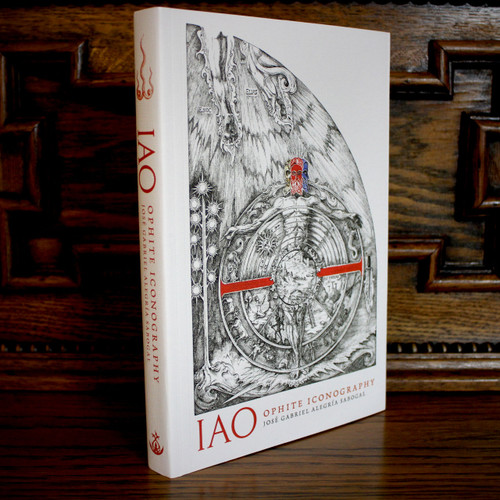
IAO is an iconographic proposal, an attempt to illustrate the Gnostic worldview and its myths as understood by the Ophites, a sect of which little is known. It is, perhaps, an exercise of imagination, of what Christian iconography could have resembled if the Ophites had survived. Visually, it follows the sequences of the Speculum Humanae Salvationis and the Biblia Pauperum, reordering their contents according to this heterodox initiative.
“Gnosticism lacks images in a remarkable way, the abstraction of its texts is only equated by the visual silence of its few and discrete remains. And yet the texts are filled with images!
“These images are, in fact, visions, allegories, and myths of a yet unexplored richness. And the ambitious proposal here is to consolidate an iconographic programme…”
Central to this initiative is the reconstruction of the Ophite diagram described by Origen of Alexandria in Contra Celsum – a complex system in which their whole cosmic vision was integrated.
“The three axis, which the images will revolve around, are three distinctive topics of the gnostic worldview: The demiurge (and his relation to the manifested world), the myth of Sophia (and the female aspects of the divine), and the ophite Christology, or the saviour as a serpent.”
IAO rejects the commonly held notion of Gnosticism as a mere form of dualism within Christianity, and explores its relationship with other religions – if only by conceptual coincidence, following Edward Conze’s comparison between Buddhism and Gnosis.
Moreover, the Ophites, by declaring Christ to be an incarnation of the Serpent of Genesis, stood outside the moral spectrum of what is now understood as Christianity. Instead, notions of non-duality can be found in the doctrines of Basilides and the idea of the Pleroma, which are explored within, both conceptually and visually.
_____________________________________________________
Table of Contents
Introduction
THE WORLD AS REFLECTION
SOPHIANIC FIGURES
THE IMAGE OF THE PLEROMA
Appendix. Sibylline Dialogues: An Imaginary Conversation with William Blake
Transcription & Translation of the Sibylline Dialogues
Bibliography
_____________________________________________________
Illustrated throughout by José Gabriel Alegría Sabogal.
Fine typography and layout by Joseph Uccello.
Paperback Edition
224 pages. Otabound [thread-sewn and glued]. Cover Material: Printed Full Colour on Fedrigoni XT Brossulin 360 gsm (thicker, textured, carton) and 'French Flaps' on both cover and back-cover). Full Colour interior, printed on heavy stock archival quality Xper Premium White 140 gsm paper.
ISBN: 978-1-989339-28-2
_____________________________________________________
Press, reviews, endorsements
Author Talk by José Gabriel Alegría Sabogal at Watkins Bookstore in London, discussing IAO and Semesilam - watch on YouTube here
Interview with on the BiblioSophia channel - watch on YouTube here
Seminar by José Gabriel Alegría Sabogal at the Occulture Conference in Berlin - watch on YouTube here
“This book is beautifully illustrated by perhaps the master of modern occult illustration, after all by its very nature it is an illumination of iconography, and as such follows in the footsteps of those past books of divine imagery that sought to reflect the supreme not just by the words written… but by being itself beautiful, breath-taking, it is as a wanderer who enters a cathedral, regardless of beliefs causing that self to literally wonder at the scene before them and know that they stand in the presence of the majestic…”
The Western Gate - read the full review here
_____________________________________________________
About the Author
José Gabriel Alegría Sabogal is an artist and art historian, born in Berlin and raised in Lima, Perú. He is currently completing his doctoral research with the Max Planck Institute for Art History, Bibliotheca Hertziana, Rome. His research interests include religious iconography and Sanskrit philology, the comparative study of religion, and Gnosticism in particular. His visual work makes use of the line technique found in renaissance copper plate engraving but applied to drawings. Both the themes and their treatment José explores are essentially anachronistic and follow the initiative of developing a symbolic language that aspires to a timeless nature.