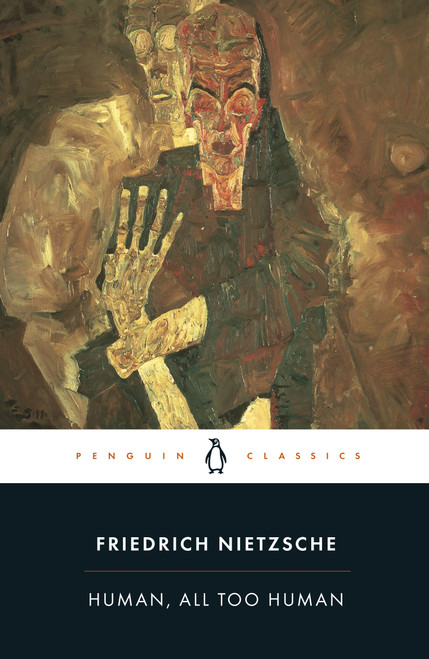
Human, All Too Human
by Friedrich Nietzsche
The book which marks the start of Nietzsche's mature philosophical writings.
Written after Nietzsche had ended his friendship with Richard Wagner and had been forced to leave academic life through ill health, Human, All Too Human can be read as a monument to his personal crisis. It also marks the point when he matured as a philosopher, rejecting the German romanticism espoused by Wagner and Schopenhauer and instead returning to sources in the French Enlightenment. Here he sets out his unsettling views in a series of 638 stunning aphorisms - assessing subjects ranging from art to arrogance, boredom to passion, science to vanity and women to youth. This work also contains the seeds of concepts crucial to Nietzsche's later philosophy, such as the will to power and the need to transcend conventional Christian morality. The result is one of the cornerstones of his life's work.
____________________________________________________________
Table of Contents
Acknowledgements
Introduction
Chronology
Further Reading
HUMAN, ALL TOO HUMAN
Preface
SECTION ONE: Of First and Last Things
SECTION TWO: On the History of Moral Feelings
SECTION THREE: Religious Life
SECTION FOUR: From the Soul of Artists and Writers
SECTION FIVE: Signs of Higher and Lower Culture
SECTION SIX: Man in Society
SECTION SEVEN: Woman and Child
SECTION EIGHT: A Look at the State
SECTION NINE: Man Alone with Himself
Among Friends: An Epilogue
Index
____________________________________________________________
Paperback Edition
320 pages. Printed card cover.
ISBN: 9780140446173
____________________________________________________________
Press, reviews, endorsements
“Enigmatic, vatic, emphatic, passionate, often breathtakingly insightful, his works together make a unique statement in the literature of European ideas.”
A.C. Grayling
____________________________________________________________
About the Author
The late Friedrich Nietzsche (1844-1900) was a German classical scholar, philosopher, and critic of culture, who became one of the most influential of all modern thinkers. His attempts to unmask the motives that underlie traditional Western religion, morality, and philosophy deeply affected generations of theologians, philosophers, psychologists, poets, novelists, and playwrights. He thought through the consequences of the triumph of the Enlightenment’s secularism—expressed in his observation that “God is dead”—in a way that determined the agenda for many of Europe’s most-celebrated intellectuals after his death. Although he was an ardent foe of nationalism, antisemitism, and power politics, his name was later invoked by fascists to advance the very things he loathed. For further reading on the misappropriation of Nietzsche’s work, read here.