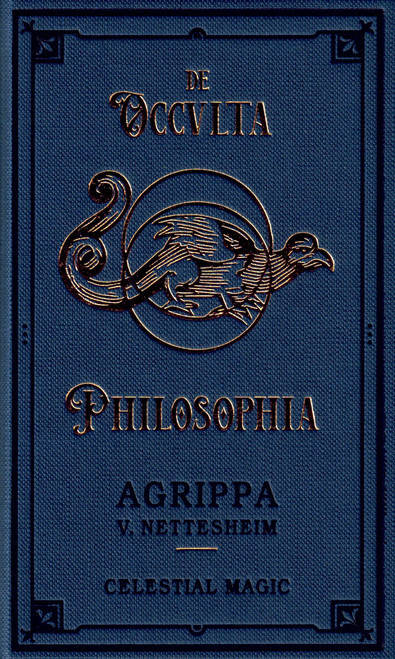
De Occulta Philosophia
Volume II - Celestial Magic
by Heinrich Cornelius Agrippa von Nettesheim
translated and introduced by Paul Summers Young
(Volume II of the De Occulta Philosophia series)
In Volume II, Celestial Magic, Agrippa explores the celestial or astral world – the realm of the stars and planets – and the practice of astrological magic. It opens with Agrippa's famous image of the magus as a "go-between" uniting the heavens and earth. Here, Agrippa details how celestial bodies (the planets, fixed stars, zodiac) emit divine influences that shape the material world. By understanding the "laws governing how the celestial influences flow down to the earth," the magus can "collaborate with nature" and produce desired effects. The work is divided into two parts:
The first part focuses on the significance of numbers, harmonics, and their connection to the divine and ideal. Agrippa's intricate descriptions of mathematical relationships within the human body is both fascinating and perplexing, leaving the reader wondering where it all leads.
A notable section, The Scales, takes readers on a poetic journey through numbers, similar to the themes in the film "Pi." Agrippa emphasises the omnipresence of mathematics in our world and suggests that understanding its secrets can unlock profound messages. This section blurs the line between inspiration and paranoia, inviting questions about the true significance of everything. Agrippa also delves into how numbers are expressed in writing, connecting music, magic, and the appreciation of our world.
The second part of the book explores the stars and their symbolism, including the Mansions of the Moon and the Decans. Unlike conventional astrology, these entities are more like ancient and unpredictable spirits, blighting and blessing without a moral compass. This controversial nature made them challenging to incorporate into serene worldviews.
Agrippa's work touches on geomancy, how celestial symbols influence the subconscious, and how the magician weaves these elements into something new. However, he tantalisingly leaves readers hanging, suggesting that they explore geomancy in more specialised texts.
About De Occulta Philosophia (Three Books of Occult Philosophy)
Heinrich Cornelius Agrippa's Three Books of Occult Philosophy holds a longstanding fascination that has spanned centuries. This influential work explores various aspects of occult and mystical knowledge. The new translation from the Latin of the 1533 edition seeks to render this foundational text accessible to a broader and contemporary audience. The publication is divided into the three traditional volumes, as well as a fourth volume containing the apocryphal Fourth Book, along with additional magical texts either written by Agrippa or attributed to him. This comprehensive collection offers readers a deeper understanding of Agrippa's contributions to the world of occult philosophy and magic.
____________________________________________________________
Cover design by Alice Rocchetti.
Hardcover Edition
309 pages. Printed and bound in Italy. Hardcover bound in Blue Fedrigoni Imitlin. 120 gram black Endpapers. Printed on 115 gsm wood-free, age-resistant Cream paper. Sewn book block, black ribbon bookmark and black Headbands. Gilding on front cover and spine.
____________________________________________________________
About the Author
The late Heinrich Cornelius Agrippa von Nettesheim (1486 – 1535) was a German Renaissance polymath, physician, legal scholar, soldier, knight, theologian, and occult writer.
Agrippa's Three Books of Occult Philosophy published in 1533 drew heavily upon Kabbalah, Hermeticism, and Neoplatonism. This work was widely influential among esotericists of the early modern period, and was condemned as heretical by the inquisitor of Cologne.