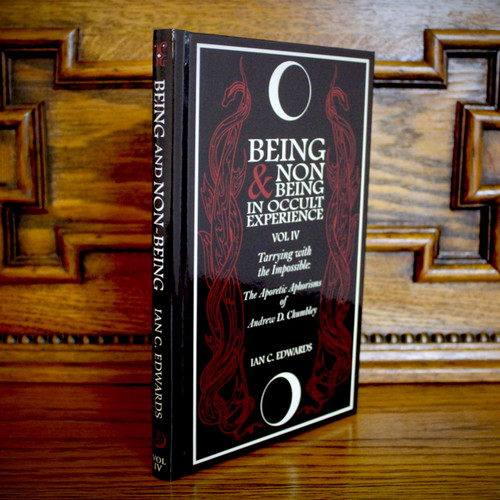
Being & Non-Being Vol. IV: Tarrying with the Impossible
The Aporetic Aphorisms of Andrew D. Chumbley
by Ian C. Edwards, PhD
(Volume IV of the Being & Non-Being in Occult Experience Series)
Tarrying with the Impossible, the final volume in the Being and Non-Being in Occult Experience series, will explore the metaphysical impasses in Andrew D. Chumbley’s posthumously published, Khiazmos: A Book Without Pages. These metaphysical impasses can be best described as aporias, which defy the law of non-contradiction. Tarrying with the Impossible begins with an “Uncanny Prologue” that sets the tone and lays the foundation for the rest of the book. Here, Ian C. Edwards starts with a mythopoetic reading of Khôra as the womb of becoming and being, an an-0ther beginning, a mythic alternative to the Genesis account with Chumbley as Khôra’s scribe, who writes from the Other-side, transmitting silences into words.
Throughout the book, Edwards is guided by Chumbley’s aphorism, “Let the contradictions be: seek not Unity, it is here now!” While this aphorism is one of many, Edwards shows how it winds its way through each and is integral to Chumbley’s Crooked Path Sorcery as a whole. The introductory chapters situate Khiazmos from the perspective of Jacques Derrida’s deconstructive reading of both Khôra and Aporia and then in relation to George Bataille’s Acéphale as described in The Sacred Conspiracy. Edwards also compares Chumbley’s “The New Flesh” in Khiazmos with Giles Deleuze and Felix Guattari’s “Body without Organs” in Anti-Oedipus: Capitalism and Schizophrenia.
“Dying” is explored as “waiting at the limits of truth” and “death” as going beyond those limits, the path of peran, the path to the beyond, a way of dying before one dies. Edwards connects death and dying in the aforementioned sense with waiting at the crossroads for the Other’s arrival and then as a sorcerous practice of being carried beyond to the Other side. He shows how this leads to a type of “Sitra Achra perception” situated within a phenomenology where being is serpentine, or in the words of Maurice Merleau-Ponty, “winding”.
Following from previous volumes in the Being and Non-Being in Occult Experience series, Edwards further expands upon his notion of the nullpunkt as the zero-point at the center of the crossroads of non-being, becoming, and being. He looks at the nullpunkt from the perspective of Chumbley’s “Point,” “Qutub,” or “I” and develops a new understanding of Heidegger’s dasein as “sorcerous being”, a type of “Acéphalic dasein”. Edwards also relates many of the key ideas in Khiazmos to Aleister Crowley’s Liber AL vel Legis, Austin Osman Spare’s The Book of Pleasure, Kenneth Grant’s Wisdom of S’lba, and C.G. Jung’s Liber Novus: The Red Book.
The essence of the book involves a careful reading of Khiazmos that integrates fundamental aspects of deconstruction and Acéphalic mysticism. Edwards titled this chapter, “Introduction to the Without Life,” a sort of a play on St. Francis de Sales, Introduction to the Devout Life. The sections in this chapter adhere closely to Chumbley’s own style. Edwards didn’t simply write about Khiazmos but ventured to write from the place that Khiazmos was written, as a “transmission through the Oracle of Silence.” The sections in the chapter explore the intersection between what Edwards calls “aporiosis,” kenosis, and apotheosis, Chumbley’s Al Q’Mu as a Cypher for the Nameless, “Silence Knowing Itself,” Chumbley’s “My Body” as Transition, The Path of the Sanctified Devil, and “The Other: From the Symbolic to the Real”. In his “Introduction to the Without Life,” Edwards highlights the importance of what he believes to be the central notions in Khiazmos – the importance Chumbley places on “Becoming Magic,” his “Godless Apotheosis,” the Geminus – Absence-in-Presence/Presence-in-Absence, and the New Flesh.
At the back of the book, there is a special Appendix section. In this section, divided into four Appendices, Edwards introduces 1) Four Acephalic Meditations that he created, using Chumbley’s “Four Excellences” as a foundation; 2) his “Thirty-One Parapraxes of the Sacred”; 3) “Schizes and Flows,” which is a brief meditation on the work of Antonin Artaud, concluding with the development of what Edwards calls his “Magic Theatre,” patterned after Hermann Hesse’s Steppenwolf, consisting of five “Collective Monologues” between Chumbley as “Alogos,” Artaud as “Artaud the Momo,” and Edwards as “(Q)ayin-Mu”, an inverted “trinity” representing the Sanctified Devil; and 4) “Vocatus atque non vocatus Deus absentia”, as what Edwards calls an “Adversarial Mantra” that the reader is invited to pray using special instructions. (This is an inversion of Jung’s famous, Vocatus atque non vocatus Deus aderit, which Edwards views as a “Geminus,” using Chumbley’s term).
Tarrying with the Impossible evocatively concludes with what Edwards calls a “Concluding Incomprehensible Postscript,” which is a play on Soren Kierkegaard’s “Concluding Unscientific Postscript.” The Postscript is more than just a conclusion to Volume IV but serves as a conclusion to Being and Non-Being in Occult Experience as a whole. In this section, Edwards explores his own “becoming magick,” and dare he say, “Apotheosis.” He notes that his realization, the “telos that guided his vision” in Being and Non-Being in Occult Experience was to heal himself from, to quote Jung from The Red Book, “the God (who) appears as our sickness…since he is our heaviest wound” and to articulate that “the practice of magic consists in making what is not understood understandable in an incomprehensible manner.” Edwards writes,
“With my scythe, letters of otherness were torn into the page, lacerating each word with the Impossible. I wounded the word to reclaim magick from the shadow of the comprehensible, returning it to the Oracle of Silence who spoke the Inceptual Wordless Word.”
____________________________________________________________
Table of Contents
Uncanny Prologue: In the Mist of Mauve
Chapter 1: Introduction - Flickers of Forked Tongue:
Toward an Occult Aporetics
Chapter 2: Othersides of the Impossible
(or Impossible Othersides) - Khôra and Aporia
Chapter 3: The Headless Way of Georges Bataille -
Headlessness and Sorcerous Flesh
Chapter 4: Reading Khiazmos - Introduction to the “Without” Life
Chapter 5: Conclusion: Dare to Know the Will of Silence!
Uncanny Epilogue: On the Seat of Lucifer’s Throne
Concluding Incomprehensible Postscript
Bibliography
Appendices
Appendix I: Acéphalic Meditations
Appendix II: Thirty-One Parapraxes of the Sacred
Appendix III: Schizes and Flows
Appendix IV: Vocatus atque non vocatus Deus absentia
____________________________________________________________
Standard Hardcover Edition - Limited to 333 copies
156 pages. Printed full colour hardcover, printed colour endpapers. Head and tail bands. Red ribbon bookmark.
____________________________________________________________
Press, reviews, endorsements
Interview with Ian C. Edwards on the BiblioSophia channel - watch on YouTube here
Book Review by Foolish Fish - watch on YouTube here
____________________________________________________________
About the Being & Non-Being in Occult Experience Series
Being and Non-Being in Occult Experience is a series of four volumes, which serves to introduce readers to a spirituality, philosophy, existential-phenomenology, and depth psychology of occult experience through the lens of the dialectical relationship (the play) between becoming, being, and non-being. The author purports an anti-foundational “language” through which occult experience can be translated, transformed, transmuted, and ultimately (ex)communicated. Here, philosophical method in and of itself becomes alchemical and tantric, taking the reader on a transubstantiative journey into the textual flesh of writers such as:
-
-
-
- Aleister Crowley (The Book of the Law and Thelema) in Volume I
- Austin Osman Spare (Zos Kia Cultus) in Volume II
- Kenneth Grant (Typhonian Ordo Templi Orientis) in Volume III
- Andrew Chumbley (Cultus Sabbati) in Volume IV
-
-
Each volume will demonstrate how Logos (Being) and A-Logos (Non-Being) continually affirm and negate one another as a means to create lived space for opposition; thereby forming a circularity of becoming through both presence and absence.
In the very writing or inscribing of occult experience, the author shows how each writer ex-communicates the illusory being/non-being dichotomy so as to create a crooked path to Divinity (by way of self-overcoming via the dialectic itself). Ritual and contemplative practice, as symbolic representations, are shown to be materialisations of the Being/Non-Being dialectic, which can function autonomously through experiences of possession, relationally through conversation and dialogue with one’s Holy Guardian Angel or Daemon, or intentionally through various forms of prayer, meditation, or yoga. That which is fundamental throughout is the suggestion that the speech act is the vehicle through which occult experience is both carried and transmitted, as ultimately any form of spiritual practice is conceived with an utterance, with its semantic, morphological structure serving to affirm and negate an adept’s existential reality, as that reality is lived in multiple self-referential and paradoxical worlds. Here, the author will argue that the task of the occultist is to hold the experience of paradox, opposing the inclination to create an idol out of or fetishise the Right-Hand or Left-Hand Path, White or Black Magick, Life or Death, Heaven or Hell, Nirvana or Samsara, etc., as incarnations of Being or Non-Being. By so doing, gnosis can be achieved by freeing psyche’s own polytheistic ground, transforming the aspirant into a Seer.
_____________________________________________________
About the Author
Dr. Ian C. Edwards is a licensed psychologist in private practice and holds both administrative and clinical positions at Duquesne University in Pennsylvania. He describes his approach as “dialectical non-dualism”, where he infuses the act of writing with method and content, through a spiritual phenomenology that attempts to inscribe the sacred as a self-referential embrace that reconciles the psycho-spiritual spaces in which dualities and oppositions such as being and non-being, good and evil, self and other, are made manifest.
He is the author of the Being and Non-Being in Occult Experience series published by Atramentous Press, as well as “The Divine Hearth and Radical Hospitality,” which appeared in PILLARS - A Wayfarer’s Hearth (Vol. 2, Issue 3) and A Druid in Psychologist’s Clothing: E. Graham Howe’s Secret Druidic Doctrine, both published by Anathema Publishing. He reads occult texts using a method that combines grammatology with a participatory epistemology that explores and describes ontologies of deific forms.