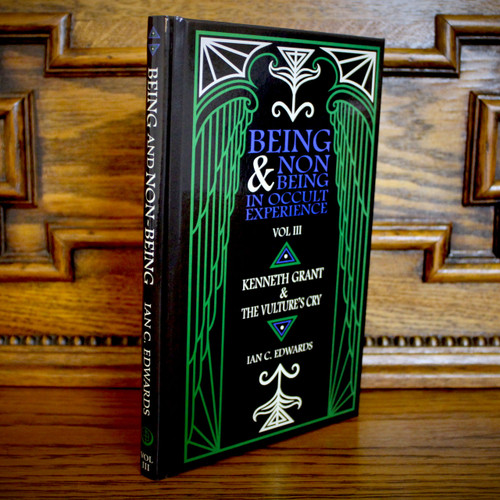
Being & Non-Being Vol. III: Kenneth Grant & The Vulture’s Cry
A Dialogue on S’lba’s Wisdom
by Ian C. Edwards, PhD
(Volume III of the Being & Non-Being in Occult Experience Series)
This volume explores many of the key notions in Kenneth Grant’s Typhonian Trilogies, in particular aspects of his occult philosophy that were more salient in his later volumes, such as, Outside the Circles of Time, Outer Gateways, and Beyond the Mauve Zone. The introductory chapter explores a Typhonian view of time, which brings together ontology and blasphemy. Paving the way for an occult anthropology that expands and even transgresses Martin Heidegger’s da-sein or being-in-the-world. (With Grant’s work, Edwards suggests that there is a shift from philosophical anthropology to occult anthropology). Here, the figure of Qayin is invoked as a sorcerous exemplar who “murders” a particular type of relationship to time and being, in the service of what Edwards has called, “sacravice,” as the “sacrifice of sacrifice,” and “skinfulness” as a transgressive-transcendent relationship to “sinfulness.”
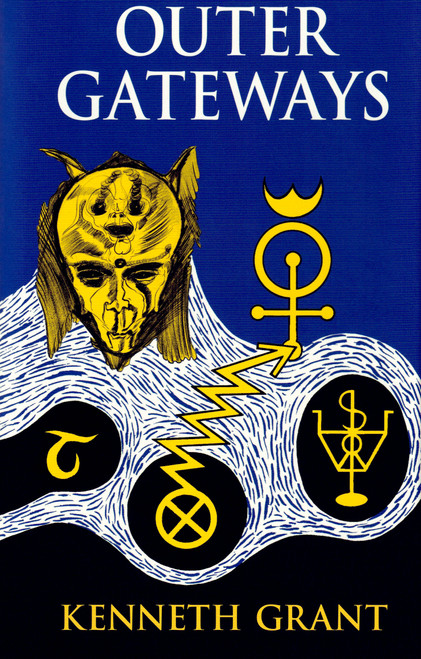
In articulating a phenomenology of the transmission experience, in the sense of a being receiving wisdom or transmitted knowledge from one Universe to the next, what Grant and Michael Bertiaux would describe as Universe A and Universe B, the book will explore terrestrial and non-terrestrial (extra-terrestrial) being, space, and time. It will look at the idea of the “dead name” as put forward in H.P. Lovecraft’s Necronomicon and apply it to names, such as, Aiwass (Aleister Crowley), Aossic (Grant), and Al Hazred (Lovecraft). Volume III explores Grant’s understanding of “dream control” and look at the Mauve Zone as a perspective or vantage point that a magician or sorcerer can take relative to their position in each world or Universe and learn to “dream while awake.” The essence of the book will be a dialogue on the Wisdom of S’lba, a transmitted text that was received by Grant and the Nu-Isis Lodge as early as 1939 and published in Outer Gateways, which is a Mauve Zone (or beyond) “commentary” that is being called, “The Vulture’s Cry.”
The Vulture’s Cry was written from a mauve zone perspective, using Grant’s “dream control” technique and Martin Heidegger’s “meditative thinking.” Edwards abandons his own name as an author, putting it under erasure, assuming the dead name, “(Q)ayin-Mu,” to dialogue with Grant’s Aossic. The commentary, both in content and style is faithful to Grant’s suggestion that,
“Words are a magician’s magical instruments, and their vibrations must produce not merely arbitrary noise but an elaborate symphony of tonal vibrations, which trigger a series of increasingly profound echoes in the consciousness of his readers. One cannot over-emphasise or over-estimate this subtle form of alchemy, for it is in the nuances and not necessarily in the rational meanings of the words and numbers employed that magick resides.”
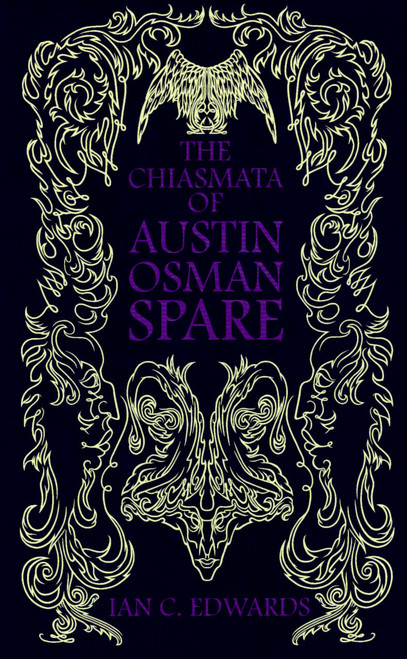
The commentary is not interested in reducing meaning to what can be “understood” or “comprehended.” Rather, it is interested in exploring Austin Osman Spare’s “Neither-Neither” as found in language and the absolute irreducibility of the signified by using signifiers that shock the reader into thinking beyond the word, moving from Logos to ALogos. This exploration of the irreducibility and betweenness of language is what Edwards has called his, “Mu Working.”
The Vulture’s Cry is written as a series of brief meditations - over 200 in all - that serve as a compendium of occult evocations rather than instructions. Rather than a path to be followed, the evocations are intended to call the reader toward discovering their own path, their own will, their own “law,” all under the guise of wearing one of S’lba’s “masques.”
The Vulture’s Cry contains many footnotes, connecting the commentary to the writings of Dogen, Friedrich Nietzsche, Heidegger, Emil Cioran, and Jacques Lacan to name only a few. The book concludes with a “Profession of Faithlessness,” which is an inversion of the Catholic “Profession of Faith.”
The Vulture’s Cry requires that it not be believed for it to be “true.” This is a variation of Spare’s “true belief” and is in keeping with Cioran’s atheism, “I will only believe in a god that doesn’t believe in himself.” In essence, the book is an invitation to believe through not believing. If some books are to be burned after they have been written and read, this one is not to be believed. And like Crowley’s Book of Lies as a book of “breaks”, The Vulture’s Cry is a book of “nots.”
____________________________________________________________
Table of Contents
Uncanny Prologue
Chapter 1: Introduction - Kenneth Grant’s Typhonian View of Time
Chapter 2: Kenneth Grant’s Occult Anthropology
Chapter 3: Names of the Dead and Creative Occultism
Chapter 4: The Initiation of Aossic and the Alogoi of (Q)ayin-Mu
Chapter 5: The Vulture’s Cry
Uncanny Epilogue
Postscript
Bibliography
____________________________________________________________
Standard Hardcover Edition - Limited to 333 copies
182 pages. Printed full colour hardcover, printed colour endpapers. Head and tail bands. Red ribbon bookmark.
____________________________________________________________
Press, reviews, endorsements
Interview with Ian C. Edwards on the BiblioSophia channel - watch on YouTube here
Book Review by Foolish Fish - watch on YouTube here
____________________________________________________________
About the Being & Non-Being in Occult Experience Series
Being and Non-Being in Occult Experience is a series of four volumes, which serves to introduce readers to a spirituality, philosophy, existential-phenomenology, and depth psychology of occult experience through the lens of the dialectical relationship (the play) between becoming, being, and non-being. The author purports an anti-foundational “language” through which occult experience can be translated, transformed, transmuted, and ultimately (ex)communicated. Here, philosophical method in and of itself becomes alchemical and tantric, taking the reader on a transubstantiative journey into the textual flesh of writers such as:
-
-
-
- Aleister Crowley (The Book of the Law and Thelema) in Volume I
- Austin Osman Spare (Zos Kia Cultus) in Volume II
- Kenneth Grant (Typhonian Ordo Templi Orientis) in Volume III
- Andrew Chumbley (Cultus Sabbati) in Volume IV
-
-
Each volume will demonstrate how Logos (Being) and A-Logos (Non-Being) continually affirm and negate one another as a means to create lived space for opposition; thereby forming a circularity of becoming through both presence and absence.
In the very writing or inscribing of occult experience, the author shows how each writer ex-communicates the illusory being/non-being dichotomy so as to create a crooked path to Divinity (by way of self-overcoming via the dialectic itself). Ritual and contemplative practice, as symbolic representations, are shown to be materialisations of the Being/Non-Being dialectic, which can function autonomously through experiences of possession, relationally through conversation and dialogue with one’s Holy Guardian Angel or Daemon, or intentionally through various forms of prayer, meditation, or yoga. That which is fundamental throughout is the suggestion that the speech act is the vehicle through which occult experience is both carried and transmitted, as ultimately any form of spiritual practice is conceived with an utterance, with its semantic, morphological structure serving to affirm and negate an adept’s existential reality, as that reality is lived in multiple self-referential and paradoxical worlds. Here, the author will argue that the task of the occultist is to hold the experience of paradox, opposing the inclination to create an idol out of or fetishise the Right-Hand or Left-Hand Path, White or Black Magick, Life or Death, Heaven or Hell, Nirvana or Samsara, etc., as incarnations of Being or Non-Being. By so doing, gnosis can be achieved by freeing psyche’s own polytheistic ground, transforming the aspirant into a Seer.
_____________________________________________________
About the Author
Dr. Ian C. Edwards is a licensed psychologist in private practice and holds both administrative and clinical positions at Duquesne University in Pennsylvania. He describes his approach as “dialectical non-dualism”, where he infuses the act of writing with method and content, through a spiritual phenomenology that attempts to inscribe the sacred as a self-referential embrace that reconciles the psycho-spiritual spaces in which dualities and oppositions such as being and non-being, good and evil, self and other, are made manifest.
He is the author of the Being and Non-Being in Occult Experience series published by Atramentous Press, as well as “The Divine Hearth and Radical Hospitality,” which appeared in PILLARS - A Wayfarer’s Hearth (Vol. 2, Issue 3) and A Druid in Psychologist’s Clothing: E. Graham Howe’s Secret Druidic Doctrine, both published by Anathema Publishing. He reads occult texts using a method that combines grammatology with a participatory epistemology that explores and describes ontologies of deific forms.