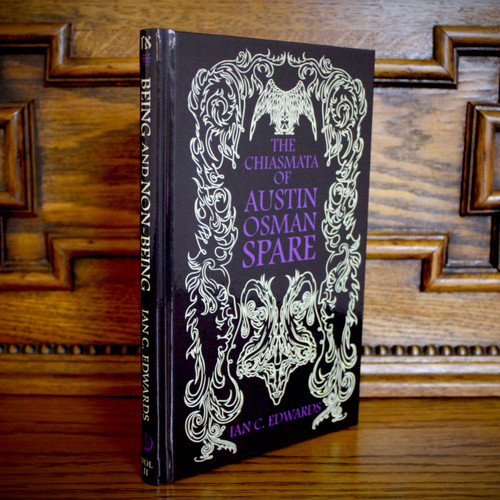
Being & Non-Being Vol. II: The Chiasmata of Austin Osman Spare
Toward a Participatory Epistemology of the Flesh
by Ian C. Edwards, PhD
(Volume II of the Being & Non-Being in Occult Experience Series)
This volume will be an opportunity to experience the writings and art of Austin Osman Spare, in particular, The Book of Pleasure: The Psychology of Ecstasy, through the lens of thinkers such as; Friedrich Nietzsche, Martin Heidegger, Maurice Merleau-Ponty, Georges Bataille, Pierre Klossowski, Jacques Lacan, and Jacques Derrida. In the contemplative traditions, Spare’s text will be compared to Taoism, the writings of Zen Buddhist Master Hui-neng, and the mystical poetry of St. John of the Cross. Whereas one of the major objectives of Being and Non-Being in Occult Experience Volume I was to push the written word to its limits, the second volume has a simpler style but is more conceptually complex. Here, readers will be introduced to what is being called an "occult grammatology" and the notion of a “Hekatian Self,” congruent with Spare’s notion of Kia or the “Inner Woman,” focusing on Hekate’s aspect as Goddess of the Crossroads, which paves the way for a unique "Hekatian Phenomenology" that includes an exploration of betweenness found in Spare’s work. Volume II will also explore:
- The Importance of Synesthetic Perception and Experience: Shifting from Synesthesia to what Spare calls, “Telesthesia.”
- The Oracular in Spare’s Writings and Art
- Kenneth Grant and the Reification of Appetence: Spare contra Freud
- The Neither-Neither as a Logos for Kia
- The Kiacization of Desire
- The Death Posture as a way of Transgressing the Law of Duality
- Between Good and Evil: The Ethics of Self-Love
- Nietzsche the “last metaphysician” and Spare the “last occultist.”
- Post-Death of God Occultism
The book is bold, even brazen in its endeavour, which can be thought of as a vision whose text is flesh, a body without organs, and as a path with a series of path marks, a myriad of traces that signify a meeting between the past and future, opening up the possibility for a radical reappropriation of becoming, what can be called Spare’s second (be)coming, as an induction of time, the circularity of eternity that rotates through being, where it is not being that becomes but the becoming of time through being. The book shows how Spare illustrates and inscribes the intertwining of non-being, becoming, and being, with his writings and art portraying it in different forms, which transcend and transgress all ontologies that attempt to describe it as part of a metaphysics of presence. Rather than illustrate the book with Spare’s art, which has been done before with many books on his work, this volume, which offers a “new wine,” does so through “new wineskins,” through the art of Carolyn Hamilton-Giles, which complements the text and portrays in image its chiasmic structure, being a direct, immediate response to Spare, using his art and writings to invoke new forms, which follows Spare in spirit, charting a new way to experience his The Book of Pleasure.
_____________________________________________________
Table of Contents
Uncanny Prologue
PART 1: INTRODUCTION
Chapter 1: On the Importance of Grammatology
for Reading (Occult Texts)
Chapter 2: Towards a Participatory Epistemology of the Flesh:
Austin Osman Spare's Occult Grammatology of Pleasure
PART II: THE CHIASMATA OF AUSTIN OSMAN SPARE
Chiasma 1: Kenneth Grant and the reification of Appetence:
Spare contra Freud
Chiasma 2: In the Beginning was the primal Id...
Chiasma 3: The Neither-Neither as a Logos for Kia:
The Nullpunkt of the Hekatean Self
Chiasma 4: The Death Posture as a Dialogue Between
Theoria and Praxis: Transgressing the Law of Duality
Chiasma 5: Between Good and Evil:
The Ontology and Ethics of the Neither-Neither
Chiasma 6: From Self-Knowledge to Self-Love:
A Post-Death of God Occultism
Chiasma 7: Sigilizing Belief: My Self, My Self,
why have I abandoned You!?
Chiasma 8: Conclusion: The Headless Ouroboros
Uncanny Epilogue
Appendix I: Chiasmatic Meditation
Appendix II: Summary of the Hekatean Self
Appendix III: What is in a Name? From Chiasmata to Kiasmata
Appendix IV: In Nomine Diablos Mantra
Appendix V: Headless Ouroboros Meditation
Bibliography
____________________________________________________________
Standard Hardcover Edition - Limited to 333 copies
172 pages. Printed full colour hardcover, printed colour endpapers. Head and tail bands. Purple ribbon bookmark.
____________________________________________________________
Press, reviews, endorsements
Author Talk by Ian C. Edwards at Watkins Books - watch on YouTube here
Interview with Ian C. Edwards on the BiblioSophia channel - watch on YouTube here
Book Review by Foolish Fish - watch on YouTube here
____________________________________________________________
About the Being & Non-Being in Occult Experience Series
Being and Non-Being in Occult Experience is a series of four volumes, which serves to introduce readers to a spirituality, philosophy, existential-phenomenology, and depth psychology of occult experience through the lens of the dialectical relationship (the play) between becoming, being, and non-being. The author purports an anti-foundational “language” through which occult experience can be translated, transformed, transmuted, and ultimately (ex)communicated. Here, philosophical method in and of itself becomes alchemical and tantric, taking the reader on a transubstantiative journey into the textual flesh of writers such as:
-
-
-
- Aleister Crowley (The Book of the Law and Thelema) in Volume I
- Austin Osman Spare (Zos Kia Cultus) in Volume II
- Kenneth Grant (Typhonian Ordo Templi Orientis) in Volume III
- Andrew Chumbley (Cultus Sabbati) in Volume IV
-
-
Each volume will demonstrate how Logos (Being) and A-Logos (Non-Being) continually affirm and negate one another as a means to create lived space for opposition; thereby forming a circularity of becoming through both presence and absence.
In the very writing or inscribing of occult experience, the author shows how each writer ex-communicates the illusory being/non-being dichotomy so as to create a crooked path to Divinity (by way of self-overcoming via the dialectic itself). Ritual and contemplative practice, as symbolic representations, are shown to be materialisations of the Being/Non-Being dialectic, which can function autonomously through experiences of possession, relationally through conversation and dialogue with one’s Holy Guardian Angel or Daemon, or intentionally through various forms of prayer, meditation, or yoga. That which is fundamental throughout is the suggestion that the speech act is the vehicle through which occult experience is both carried and transmitted, as ultimately any form of spiritual practice is conceived with an utterance, with its semantic, morphological structure serving to affirm and negate an adept’s existential reality, as that reality is lived in multiple self-referential and paradoxical worlds. Here, the author will argue that the task of the occultist is to hold the experience of paradox, opposing the inclination to create an idol out of or fetishise the Right-Hand or Left-Hand Path, White or Black Magick, Life or Death, Heaven or Hell, Nirvana or Samsara, etc., as incarnations of Being or Non-Being. By so doing, gnosis can be achieved by freeing psyche’s own polytheistic ground, transforming the aspirant into a Seer.
____________________________________________________________
About the Author
Dr. Ian C. Edwards is a licensed psychologist in private practice and holds both administrative and clinical positions at Duquesne University in Pennsylvania. He describes his approach as “dialectical non-dualism”, where he infuses the act of writing with method and content, through a spiritual phenomenology that attempts to inscribe the sacred as a self-referential embrace that reconciles the psycho-spiritual spaces in which dualities and oppositions such as being and non-being, good and evil, self and other, are made manifest.
He is the author of the Being and Non-Being in Occult Experience series published by Atramentous Press, as well as “The Divine Hearth and Radical Hospitality,” which appeared in PILLARS - A Wayfarer’s Hearth (Vol. 2, Issue 3) and A Druid in Psychologist’s Clothing: E. Graham Howe’s Secret Druidic Doctrine, both published by Anathema Publishing. He reads occult texts using a method that combines grammatology with a participatory epistemology that explores and describes ontologies of deific forms.