A Druid in Psychologist’s Clothing
E. Graham Howe’s Secret Druidic Doctrine
by Ian C. Edwards, PhD
Imagine a man who influenced the likes of Alan Watts, was a friend of Krishnamurti, whose work was lauded by Henry Miller, and had the audacity to challenge the great psychiatrist, C.G. Jung, during one of Jung’s own seminars. Also imagine that this very same man who authored thirteen books and countless articles on the relationship between psychology, psychotherapy, philosophy, spiritual practice, and Druidry was left out of the history books, and pushed to the margins of obscurity. Who was this man? This man was the early 20th-century British psychologist and Druid, E. Graham Howe.
Howe was a master psychologist but even more so a Druid, whom he described as being, “masters of the art of living.” He was a Druid in psychologist’s clothing, a psychologist who used psychology and psychotherapy to convey his secret Druidic doctrine. Like C.G. Jung’s Gnostically influenced Liber Novus (The Red Book), which was the secret foundation for all of his psychological writings, Howe’s Druidry was the secret foundation for his own writings. Howe’s Druidry had one primary aim, which was to heal psychological suffering. Whether he was referencing psychology, philosophy, or spirituality, Howe pointed to the art of healing in them all.
E. Graham Howe was one of the first psychologists to integrate spiritual practice with psychotherapy. Because he did so during a time when psychoanalysis was being established as a dogma, Howe was marginalized and even anathematized by the various psychoanalytic schools. This book situates Howe within the history of psychoanalysis, showing his work in relation to Sigmund Freud, C.G. Jung, and Alfred Adler just to name a few. It also provides a summary and reading of his metaphysical psychology, illustrating his views on depression, love, time, war, self-knowledge, psychotherapy as a way of being, and more. The book presents some Druidic foundations of Howe’ psychology, in the spirit of the 18th – 19th century Welsh poet, Iolo Morganwg, whose own Druidry, like Howe’s, was inspired, emphasizing more of the Druidic soul rather than blind allegiance to any tradition or belief system.
Included in this book are forewords by author and Druid, John Michael Greer, and Jungian analyst and author, Stanton Marlan.
_____________________________________________________
Table of Contents
Foreword I John Michael Greer
Foreword II Stanton Marlan, PhD, ABPP
PART I INTRODUCTION
Chapter 1 Can You Tell a Druid by his Clothing?
PART II HOWE’S PLACE IN THE HISTORY OF PSYCHOANALYSIS
Chapter 2 How(e ) Should I Compare Thee?
Chapter 3 The Unwilling Expression of Unwillingness
Chapter 4 On the Heights of Inferiority
Chapter 5 The Infinite and Everchanging Varieties of Love
Chapter 6 The Multi-Dimensional Self
PART III THE ESSENCE OF HOWE’S PSYCHOLOGY
Chapter 7 Relationship as Self-Knowledge
Chapter 8 Howe’s Metaphysical Psychology
Chapter 9 Is There a Fourth Dimension?
Chapter 10 War Dance
Chapter 11 Psychotherapy as a Way of Being
Chapter 12 Howe’s Via Positiva
PART IV DRUIDIC FOUNDATIONS OF HOWE’S PSYCHOLOGY
Chapter 13 Einigen the Giant
Chapter 14 An Ontology of Awen
Chapter 15 A Druidic Elemental Psychology
Chapter 16 Living the Three Circles of Manifestation
PART V CONCLUSION
Chapter 17 A Healer for the 21st Century
PART VI APPENDICES
Appendix I Three Versions of the Druid’s Prayer
Appendix II Howe’s Method of Meditation
Appendix III Walking Under the Dolmen Arch
Bibliography
_____________________________________________________
Illustrated by Philipp Müller (aka. Black Philipp).
Fine typography & layout by Joseph Uccello.
Collector’s Edition - Limited to 1000 copies
272 pages. Hardbound 100pts, Quarter-bound in Skivertex Blue Galuchat and Assuan Dark Navy Blue fine Italian bookcloth. Gold foil blocking on rounded spine bleeding onto both front and back. Blind Deboss details onto both front and back as well. B&W interior, with Constellation Jade Silk Endpapers. Gold Headbands & Gold Silk Ribbon Marker. Printed on Munken Pure Smooth Cream 150gsm archive-quality paper. Comes with a numbered tipped-in carton-plate signed by the Author.
ISBN: 978-1-989339-25-1
_____________________________________________________
Press, reviews, endorsements
Book Review by Foolish Fish - watch on YouTube here
Book Review by Frater R∴C∴ - watch on YouTube here
Author Talk by Dr Ian C. Edwards at Watkins Books - watch on YouTube here
Interview with Dr Ian C. Edwards on the Howl in the Wilderness Podcast - watch on YouTube here
Interview with Dr Ian C. Edwards on the Frater R∴C∴ Hermetic Podcast - watch on YouTube here
_____________________________________________________
About the Author
Dr. Ian C. Edwards is a licensed psychologist in private practice and holds both administrative and clinical positions at Duquesne University in Pennsylvania. He describes his approach as “dialectical non-dualism”, where he infuses the act of writing with method and content, through a spiritual phenomenology that attempts to inscribe the sacred as a self-referential embrace that reconciles the psycho-spiritual spaces in which dualities and oppositions such as being and non-being, good and evil, self and other, are made manifest.
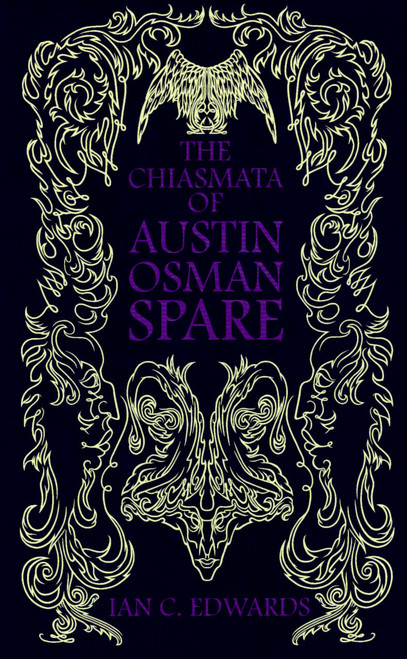
He is the author of the Being and Non-Being in Occult Experience series published by Atramentous Press, as well as “The Divine Hearth and Radical Hospitality,” which appeared in PILLARS - A Wayfarer’s Hearth (Vol. 2, Issue 3) and A Druid in Psychologist’s Clothing: E. Graham Howe’s Secret Druidic Doctrine, both published by Anathema Publishing. He reads occult texts using a method that combines grammatology with a participatory epistemology that explores and describes ontologies of deific forms.